8.3 Hodge theory of simplicial schemes
For a separated simplicial scheme (or separated simplicial algebraic space) X^\bullet, we will have to consider diagrams
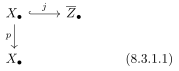
of simplicial schemes satisfying:
- The morphism j is an open immersion with dense image; \overline{Z}_\bullet is proper.
- The evident morphisms Z_n\to(\operatorname{cosq}_{n-1}^{X_\bullet}\operatorname{sq}_{n-1}Z_\bullet)_n are proper and surjective.
For reduced \overline{Z}_\bullet, we can consider j as a simplicial object in the category \mathscr{C} of pairs (Y,\overline{Y}) consisting of a proper reduced scheme \overline{Y} and a dense (Zariski) open Y of \overline{Y}. The category \mathscr{C} satisfies , which allows us to apply the analogue of (6.2.4).
—
For every separated simplicial scheme X_\bullet, there exists a diagram of the form (8.3.1.1) that satisfies (a) and (b), and such that \overline{Z}_\bullet is smooth and proper, and Z_\bullet is the complement of a normal crossing divisor.
Let F\colon {X_\bullet}_1\to{X_\bullet}_2 be a morphism of separated simplicial schemes. Let ({X_\bullet}_i,{Z_\bullet}_i,{\overline{Z}_\bullet}_i)_{i=1,2} be diagrams of the form (8.3.1.1) that satisfy (a) and (b). Then there exists ({X_\bullet}_1,Z_\bullet,\overline{Z}_\bullet) as in (i), and a commutative diagram
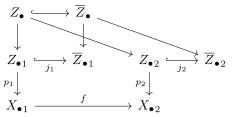
Proof. The proof, which is a more complicated analogue of (6.2.5), is left to the reader.
Consider a diagram of the form (8.3.1.1) as in (ii) of (8.3.2). By (V) of (5.3.5), the map \operatorname{H}^\bullet{(X_\bullet,\mathbb{Z})\to\operatorname{H}^\bullet(Z_\bullet,\mathbb{Z})} is an isomorphism. In (8.1.19) and (8.1.20), we endowed \operatorname{H}^\bullet(Z_\bullet,\mathbb{Z}) with a mixed Hodge structure, and obtained a mixed Hodge structure on \operatorname{H}^\bullet(X_\bullet,\mathbb{Z}). This is independent of the choice of diagram of the form (8.3.1.1): by (ii) of (8.3.2) for f=\mathrm{Id}. any two systems ({Z_\bullet}_i,{\overline{Z}_\bullet}_i,p_i)_{i=1,2} are always covered by a third (Z_\bullet,\overline{Z}_\bullet,p), whence a commutative diagram of isomorphisms
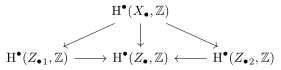
The mixed Hodge structure of \operatorname{H}^\bullet(X_\bullet,\mathbb{Z}) is the one defined above.
It follows from (ii) of (8.3.2) that this mixed Hodge structure is functorial in X_\bullet.
Let X_\bullet be a separated simplicial scheme. Then the spectral sequence E_1^{pq} = \operatorname{H}^q(X_p,\mathbb{Z}) \Rightarrow\operatorname{H}^{p+q}(X_\bullet,\mathbb{Z}) is a spectral sequence of mixed Hodge structures.
For a diagram as in (8.3.1.1), the maps p_n\colon Z_n\to X_n are proper and surjective. We can thus apply (6.2.4) to the category of simplicial objects in the category \mathscr{C} (8.3.1) to obtain, as in (6.2.5), the following lemma:
Let X_\bullet be a separated simplicial scheme. Then there exists a bisimplicial scheme Z_{\bullet\bullet} augmented over X_\bullet \varepsilon_{n,m} \colon Z_{n,m} \to X_n and i\colon Z_{\bullet\bullet}\hookrightarrow\overline{Z}_{\bullet\bullet} such that:
- \overline{Z}_{\bullet\bullet} is a smooth and proper bisimplicial scheme, and Z_{\bullet\bullet} is the complement of a normal crossing divisor in \overline{Z}_{\bullet\bullet};
- for all n, the augmented simplicial scheme Z_{n\bullet}\to X_n is a proper hypercover of X_n.
In (8.1.12), we endowed \operatorname{H}^\bullet(Z_{\bullet\bullet},\mathbb{Z}) with a mixed Hodge structure. If \delta\mathbb{Z}_{\bullet\bullet} is the diagonal simplicial scheme of Z_{\bullet\bullet}, then we have a commutative diagram of morphisms
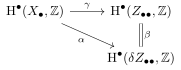
in which \beta and \gamma are isomorphisms, and \alpha and \beta are morphisms of mixed Hodge structures; \gamma is thus an isomorphism of mixed Hodge structures.
We have a morphism of spectral sequences
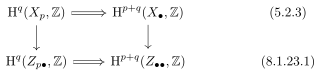
and this morphism is an isomorphism that is compatible with the mixed Hodge structures, so that (8.3.5) follows from (8.1.23).
Let X_\bullet be a simplicial scheme, not necessarily separated. Then there exists a separated simplicial scheme Y_\bullet and u\colon Y_\bullet\to X_\bullet such that, for n\geq0, the map u'_n\colon Y_n\to(\operatorname{cosq}_{n-1}^{X_\bullet}\operatorname{sq}_{n-1}Y_\bullet)_n is étale and surjective (for example, the sum of opens of an open cover).
The map u^\bullet\colon\operatorname{H}^\bullet(X_\bullet,\mathbb{Z})\to\operatorname{H}^\bullet(Y_\bullet,\mathbb{Z}) is an isomorphism ((V) and (III) of (5.3.5)). By definition, the mixed Hodge structure of \operatorname{H}^\bullet(X_\bullet,\mathbb{Z}) is induced from that of \operatorname{H}^\bullet(Y_\bullet,\mathbb{Z}) via u^\bullet. It does not depend on the choice of Y_\bullet.
For X a non-separated scheme, the mixed Hodge structure of \operatorname{H}^\bullet(X,\mathbb{Z}) is that of \operatorname{H}^\bullet(X_\bullet,\mathbb{Z}), where X_\bullet is the constant simplicial scheme defined by X. It is plausible, but not proven, that (iv) of (8.2.4) remains true for X smooth and non-separated.
Let u\colon X_\bullet\to Y_\bullet be a morphism of simplicial schemes. The relative cohomology groups \operatorname{H}^n(Y_\bullet\operatorname{mod}X_\bullet,\mathbb{Z}) are, by definition (6.3.2), the cohomology groups of the simplicial scheme C(u). They are thus endowed with a mixed Hodge structure.
The long exact sequence of relative cohomology \operatorname{H}^n(Y_\bullet,\mathbb{Z}) \to \operatorname{H}^n(X_\bullet,\mathbb{Z}) \xrightarrow{j} \operatorname{H}^{n+1}(Y_\bullet\operatorname{mod}X_\bullet,\mathbb{Z}) \to \operatorname{H}^{n+1}(Y_\bullet,\mathbb{Z}) is a long exact sequence of mixed Hodge structures.
Proof. We can reduce to the case where X_\bullet and Y_\bullet are smooth, and where, furthermore, there exists a commutative diagram

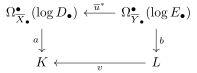
with \overline{X}_\bullet and \overline{Y}_\bullet both smooth and proper, and X_\bullet and Y_\bullet both complements of normal crossing divisors D_\bullet and E_\bullet in \overline{X}_\bullet and \overline{Y}_\bullet (respectively).
There thus exist bifiltered resolutions (graded with acyclic components) a\colon\Omega_{\overline{X}_\bullet}^\bullet(\log D_\bullet)\to K and b\colon\Omega_{\overline{Y}_\bullet}^\bullet(\log E_\bullet)\to L that fit into a commutative diagram of bifiltered complexes
(where \overline{u}^* and v are \overline{u}-morphisms). The long exact sequence in (8.3.9) is then identified with the exact sequence given by the distinguished triangle
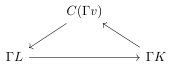
The complex C(v) over C(\overline{u}) is a bifiltered resolution of C(u^*\colon\Omega_{\overline{Y}_\bullet}^\bullet(\log E_\bullet)\to\Omega_{\overline{X}_\bullet}^\bullet(\log D_\bullet)). From this it results that the Hodge and weight filtrations of \operatorname{H}^\bullet(Y_\bullet\operatorname{mod}X_\bullet,\mathbb{C}) are induced by the filtrations of the cone C(\Gamma v), and (8.3.9) then follows formally.
Proof of (ii) of (8.2.4).
Proof. The proof proceeds by induction on N=\dim(X). We can assume X to be reduced. Let U be a smooth dense Zariski open of X, and let Y=X\setminus U. By the resolution of singularities, there exists a proper birational morphism p\colon X'\to X, with smooth source X', that induces an isomorphism from p^{-1}(U) to U. Let Y'=p^{-1}(Y). Consider, for n\geqslant N, the diagram of mixed Hodge structures

Let \Phi be the family of supports of U consisting of those A\subset U such that, in X (or, equivalently, in X'), \overline{A}\subset U. We have that \operatorname{H}^n(X\operatorname{mod}Y,\mathbb{Z}) = \operatorname{H}_\Phi^n(U,\mathbb{Z}) = \operatorname{H}^n(X'\operatorname{mod}Y',\mathbb{Z}) and so the arrow denoted p^* is an isomorphism.
For h^{pq} a non-zero Hodge number of one of the mixed Hodge structures in play, we have:
- for \operatorname{H}^n(X',\mathbb{Z}), (p,q)\in[n-N,N]\times[n-N,N]
- for \operatorname{H}^{n-1}(Y',\mathbb{Z}), (p,q)\in[n-N,N-1]\times[n-N,N-1]
- for \operatorname{H}^n(X'\operatorname{mod}Y',\mathbb{Z})=\operatorname{H}^n(X\operatorname{mod}Y,\mathbb{Z}), (p,q)\in[n-N,N]\times[n-N,N]
- for \operatorname{H}^n(Y,\mathbb{Z}), (p,q)\in[n-N+1,N-1]\times[n-N+1,N-1]
- for \operatorname{H}^n(X,\mathbb{Z}), (p,q)\in[n-N,N]\times[n-N,N]
- follows from the fact that X' is smooth, and from the fact that the claim is true for the {}_WE_1 pages of the spectral sequence (3.2.4.1).
- and (d) follow from the inductive hypothesis: we have that \dim Y,\dim Y'\leqslant N-1.
- follows from (a) and (b), and (e) follows from (c) and (d). This finishes the proof.