8.2 Separated algebraic spaces
Let X be a scheme (or an algebraic space) of finite type over \mathbb{C}, and assume it to be separated. Then there exists a diagram X \xleftarrow{\alpha} Y_\bullet \hookrightarrow \overline{Y}_\bullet \tag{8.2.1.1} in which Y_\bullet is the complement of a normal crossing divisor in a smooth and proper simplicial scheme \overline{Y}_\bullet, and is a proper hypercover of X. We have ((II) of (5.3.5)) \operatorname{H}^\bullet(X) \xrightarrow{\sim}\operatorname{H}^\bullet(Y_\bullet). \tag{8.2.1.2}
In (8.1.19) , we endow \operatorname{H}^\bullet(Y_\bullet) with a mixed Hodge structure. Let \operatorname{\mathscr{H}}(\alpha) be the mixed Hodge structure on \operatorname{H}^\bullet(X) induced by (8.2.1.2).
With the above notation, the mixed Hodge structure \operatorname{\mathscr{H}}(\alpha) on \operatorname{H}^\bullet(X) is independent of the choice of \alpha. We call it the mixed Hodge structure of \operatorname{H}^\bullet(X,\mathbb{Z}). For every morphism f\colon X_1\to X_2 of schemes, f^*\colon\operatorname{H}^\bullet(X_2)\to\operatorname{H}^\bullet(X_1) is a morphism of mixed Hodge structures.
For smooth X, we can show, by taking \overline{Y}_\bullet to be a constant simplicial scheme, that the mixed Hodge structure in (8.2.2) coincides with that defined in (3.2.12).
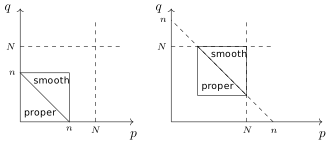
The pairs (p,q) such that the Hodge number h^{pq} of \operatorname{H}^n(X) are non-zero satisfy the following conditions:
- (p,q)\in[0,n]\times[0,n].
- If \dim X=N, and n\geqslant N, then (p,q)\in[n-N,N]\times[n-N,N].
- If X is proper, then p+q\leqslant n.
- If X is smooth, then p+q\geqslant n. The same conclusion holds if X is an equidimensional “rational homology manifold” of dimension N, i.e. if, for all x\in X, \operatorname{H}^i_{(x)}(X,\mathbb{Q}) = \begin{cases} 0 &\text{if }i\neq 2N \\\mathbb{Q}&\text{if }i=2N. \end{cases}
Proof. Claim (ii) will be proven in (8.3.10). Claim (i) follows from (iii) of (8.1.20). For proper X, we can find a diagram as in (8.2.1.1) in which Y_\bullet=\overline{Y}_\bullet, and (iii) then follows from (iv) of (8.1.20). For smooth X, (iv) follows from (8.2.3) and (3.2.15). The general case then follows: if p\colon\widetilde{X}\to X is a resolution of singularities of X, then p^*\colon\operatorname{H}^\bullet(X,\mathbb{Q})\to\operatorname{H}^\bullet(\widetilde{X},\mathbb{Q}) is injective, since the Poincaré dual transpose p_! of p^*\colon\operatorname{H}^\bullet_\mathrm{c}(X,\mathbb{Q})\to\operatorname{H}^\bullet_\mathrm{c}(\widetilde{X},\mathbb{Q}) is a retraction for it.
Suppose that X is proper. If u\colon Y\to X is a surjective proper morphism, with Y smooth, then the weight-n quotient of \operatorname{H}^n(X,\mathbb{Q}) is the image of \operatorname{H}^n(X,\mathbb{Q}) in \operatorname{H}^n(Y,\mathbb{Q}). The sequence \operatorname{H}^n(X,\mathbb{Q}) \to \operatorname{H}^n(Y,\mathbb{Q}) \xrightarrow{\operatorname{pr}_1^*-\operatorname{pr}_2^*} \operatorname{H}^n(Y\times_X Y,\mathbb{Q}) \tag{8.2.5.1} is exact.
Proof. Let Y_\bullet be as in (8.2.1.1), with Y_0=Y and Y_\bullet=\overline{Y}_\bullet. By (ii) of (8.1.20), we have an exact sequence 0 \to \operatorname{H}^n(X,\mathbb{Q})/W^{n-1}\operatorname{H}^n(X,\mathbb{Q}) \to \operatorname{H}^n(Y_0,\mathbb{Q}) \underset{\delta_1}{\overset{\delta_0}{\rightrightarrows}} \operatorname{H}^n(Y_1,\mathbb{Q}) \tag{8.2.5.2} which implies (8.2.5) (conversely, this exact sequence can easily be deduced from (8.2.5) and (8.2.7) below).
Let Y \xrightarrow{f} X \overset{j}{\hookrightarrow} \overline{X} be morphisms of schemes. Suppose that Y is proper and X is smooth, and that \overline{X} is a smooth compactification of X. Then \operatorname{H}^\bullet(\widetilde{X},\mathbb{Q}) and \operatorname{H}^\bullet(X,\mathbb{Q}) have the same image in \operatorname{H}^\bullet(Y,\mathbb{Q}).
Proof. The proof is parallel to that of (3.2.18). It suffices to prove, for any i and any n, that \operatorname{Gr}_i^W(f^*) and \operatorname{Gr}_i^W((jf)^*) have the same image in \operatorname{Gr}_i^W\operatorname{H}^n(Y,\mathbb{Q}).
- For i>n, these images are both zero since \operatorname{Gr}_i^W\operatorname{H}^n(Y,\mathbb{Q})=0 ((iii) of (8.2.4)).
- For i<n, these images are both zero since \operatorname{Gr}_i^W\operatorname{H}^n(X,\mathbb{Q})=0 ((iv) of (8.2.4)).
- For i=n, these images are equal since \operatorname{Gr}_n^W(j^*) is surjective (3.2.17).
Let \widetilde{X} \xrightarrow{\pi} X \xrightarrow{f} Y be morphisms of schemes. Suppose that Y is smooth, X is proper, \widetilde{X} is smooth and proper, and that \pi is surjective. Then the kernels of f^* and (f\pi)^* in \operatorname{H}^\bullet(Y,\mathbb{Q}) are equal.
Proof. We will prove that \operatorname{Ker}(\operatorname{Gr}_i^W(f^*))=\operatorname{Ker}(\operatorname{Gr}_i^W((f\pi)^*)) in \operatorname{Gr}_i^W\operatorname{H}^n(Y,\mathbb{Q}).
- For i<n, these kernels are both zero since \operatorname{Gr}_i^W\operatorname{H}^n(Y,\mathbb{Q})=0 ((iv) of (8.2.4)).
- For i>n, these kernels are both all of \operatorname{Gr}_i^W\operatorname{H}^n(Y,\mathbb{Q}) since \operatorname{Gr}_i^W\operatorname{H}^n(X,\mathbb{Q})=0 ((iii) of (8.2.4)).
- For i=n, these kernels are equal since \operatorname{Gr}_n^W(\pi^*) is injective (8.2.5.2).
Let \widetilde{X} \xrightarrow{\pi} X \overset{f}{\hookrightarrow} Y be morphisms of schemes. Suppose that Y is smooth and proper, that X is a closed subscheme of Y, and that \widetilde{X} is a resolution of singularities of X. Let q=f\pi and U=Y\setminus X. Then the sequence \operatorname{H}^\bullet(\widetilde{X},\mathbb{Q}) \xrightarrow{q_!} \operatorname{H}^\bullet(Y,\mathbb{Q}) \to \operatorname{H}^\bullet(U,\mathbb{Q}) \tag{8.2.8.1} is exact.
Proof. By (8.2.7), we have that \operatorname{Ker}(f^*\colon\operatorname{H}^\bullet(Y,\mathbb{Q})\to\operatorname{H}^\bullet(X,\mathbb{Q})) = \operatorname{Ker}(q^*\colon\operatorname{H}^\bullet(Y,\mathbb{Q})\to\operatorname{H}^\bullet(\widetilde{X},\mathbb{Q})). The long exact sequence in cohomology of the pair Y,X thus gives an exact sequence \operatorname{H}_c^\bullet(U,\mathbb{Q}) \to \operatorname{H}^\bullet(Y,\mathbb{Q}) \to \operatorname{H}^\bullet(\widetilde{X},\mathbb{Q}) \tag{8.2.8.2} and (8.2.8.1) is the transpose sequence of (8.2.8.2) under Poincaré duality.
(8.2.8) is used under more general hypotheses in (Grothendieck 1968, (9.7), p. 161). As Lieberman remarked, the justification given loc. cit. is insufficient.
From (8.1.25) we deduce the following:
The Künneth isomorphisms \operatorname{H}^\bullet(X\times Y,\mathbb{Q}) \simeq \operatorname{H}^\bullet(X,\mathbb{Q})\otimes\operatorname{H}^\bullet(Y,\mathbb{Q}) are isomorphisms of mixed Hodge structures.
The cup product \operatorname{H}^\bullet(X)\otimes\operatorname{H}^\bullet(X) \to \operatorname{H}^\bullet(X) is a morphism of mixed Hodge structures.
Proof. This follows from (8.2.10) and from (8.2.2) applied to the diagonal morphism \Delta\colon X\to X\times X.