3.2 Mixed Hodge theory
We recall that, from here on, we say “scheme” to mean a scheme of finite type over \mathbb{C}, and “sheaf on S” to mean a sheaf on S^\mathrm{an}.
Let X be a smooth and separated scheme. By Nagata (Nagata 1962), X is a Zariski open of a complete scheme \overline{X}. By Hironaka (Hironaka 1964), we can take \overline{X} to be smooth and such that Y=\overline{X}\setminus X is a normal crossing divisor.
The reader who wishes to avoid the reference to Nagata can suppose X to be quasi-projective. The smooth completion \overline{X} can then be chosen to be projective and such that Y is the union of smooth divisors. If we limit ourselves to such compactifications, then we only need Hodge theory in its standard form (2.2.1).
By (3.1.7) and (3.1.8), we have \operatorname{H}^\bullet(X,\mathbb{C}) \simeq \operatorname{\mathbb{H}}^\bullet(\overline{X},\Omega_{\overline{X}}^\bullet\langle Y\rangle). We define the Hodge filtration F on the complex \Omega_{\overline{X}}^\bullet\langle Y\rangle as the filtration F^p=\sigma_{\geqslant p} given by the stupid truncations (1.4.5). On \Omega_{\overline{X}}^\bullet\langle Y\rangle, we thus have two filtrations: F and W (3.1.5).
We will need to make use of the fact that there exist bifiltered resolutions i\colon\Omega_{\overline{X}}^\bullet\langle Y\rangle\to K^\bullet such that the \operatorname{Gr}_F^p\operatorname{Gr}_n^W(K^j) are \Gamma-acyclic sheaves: \operatorname{H}^i(\overline{X},\operatorname{Gr}_F^p\operatorname{Gr}_n^W(K^j)) = 0 \qquad\text{for }i>0.
Here are two methods to construct such a resolution:
- We can take K^\bullet to be the canonical Godement resolution \mathscr{C}^\bullet(\Omega_{\overline{X}}^\bullet\langle Y\rangle), filtered by the \mathscr{C}^\bullet(W_n(\Omega_{\overline{X}}\langle Y\rangle)) and the \mathscr{C}^\bullet(F^p(\Omega_{\overline{X}}^\bullet\langle Y\rangle)). This is a bifiltered resolution since \mathscr{C}^\bullet is an exact functor.
- We can take K^\bullet to be the \mathrm{d}''-resolution of \Omega_{\overline{X}}^\bullet\langle Y\rangle. Let \Omega_{\overline{X}}^{pq} be the sheaf of C^\infty forms of degree (p,q); then K^\bullet is the simple complex associated to the double complex of the \Omega_{\overline{X}}^p\langle Y\rangle\otimes_\mathcal{O}\Omega_{\overline{X}}^{0,q} (a subcomplex of the j_*\Omega_X^{\bullet\bullet}). This complex is filtered by the F^p(\Omega_{\overline{X}}^\bullet\langle Y\rangle)\otimes\Omega_{\overline{X}}^{0,\bullet} and by the W_n(\Omega_{\overline{X}}^\bullet\langle Y\rangle)\otimes\Omega_{\overline{X}}^{0,\bullet}; to prove that this is a bifiltered resolution, we use the fact that the sheaf \mathcal{O}_\infty of complex C^\infty functions on \overline{X} is flat over \mathcal{O} (a corollary of the Malgrange C^\infty preparation theorem). The sheaves \operatorname{Gr}_F\operatorname{Gr}_W(K^\bullet) are fine, since they are sheaves of modules over the soft sheaf \mathcal{O}_\infty.
With the notation of (3.2.3), the complex cohomology of X appears as the cohomology of the bifiltered complex \Gamma(\overline{X},K^\bullet). We thus have two spectral sequences abutting to \operatorname{H}^\bullet(X,\mathbb{C}). They can be written, with the notation of (3.1.4), as: {}_WE_1^{pq} = \operatorname{\mathbb{H}}^{p+q}(\overline{X},\varepsilon_{\overline{X}}^{-p}[p]) = \operatorname{\mathbb{H}}^{2p+q}(\widetilde{Y}^p,\varepsilon^{-q}) \Rightarrow\operatorname{H}^n(X,\mathbb{C}) \tag{3.2.4.1} {}_FE_1^{pq} = \operatorname{H}^q(\overline{X},\Omega_{\overline{X}}^p\langle Y\rangle) \Rightarrow\operatorname{H}^n(X,\mathbb{C}). \tag{3.2.4.2} The first of these, up to the renumbering {}_WE_1^{pq}\mapsto E_2^{2p+q,-p}, is exactly the Leray spectral sequence of the inclusion j.
—
- On the pages {}_WE_r^{pq} of the spectral sequence (3.2.4.1), the first direct filtration, the second direct filtration, and the recurrent filtration defined by F all coincide.
- The filtration on \operatorname{H}^n(X,\mathbb{C}) that is the abutment of the spectral sequence {}_WE comes from a filtration W of \operatorname{H}^n(X,\mathbb{Q}). Neither it, nor the filtration F that is the abutment of the spectral sequence {}_FE, depend on the choice of compactification \overline{X} of X or on the choice of K^\bullet.
- The filtrations W[n] (1.1.2) and F define on \operatorname{H}^n(X,\mathbb{Z}) a mixed Hodge structure, functorially in X.
By , the spectral sequence {}_WE is the Leray spectral sequence for j_* (up to renumbering). It is thus induced by tensoring a \mathbb{Q}-vectorial spectral sequence with \mathbb{C}, and so the first claim of (ii) is true. Complex conjugation acts on the {}_WE; it can be calculated via (3.1.10).
The hypercohomology spectral sequences of the filtered complexes \operatorname{Gr}_n^W(\Omega_{\overline{X}}^\bullet\langle Y\rangle), endowed with the filtration induced by the Hodge filtration, degenerate at the E_1 page.
Proof. Define the Y^n and the \widetilde{Y}^n as in (3.1.4), and let i_n\colon\widetilde{Y}^n\to X. By (3.1.5.2), we have \operatorname{Gr}_n^W(\Omega_{\overline{X}}^\bullet\langle Y\rangle) \sim (i_n)_*\Omega_{\widetilde{Y}^n}^\bullet(\varepsilon^n)[-n]. Furthermore, the Hodge filtration induces the stupid filtration (1.4.5), and so the spectral sequence in (3.2.6) is given by translations of the degrees of the classical spectral sequence E_1^{pq} = \operatorname{H}^q(\widetilde{Y}^n,\Omega_{\widetilde{Y}^n}^p(\varepsilon^n)) \Rightarrow\operatorname{H}^{p+q}(\widetilde{Y}^n,\varepsilon^n).
If \overline{X} is projective and Y the union of smooth divisors, then \widetilde{Y}^n is projective, \varepsilon^n is a trivial local system, and classical Hodge theory (2.2.1) gives the degeneration claimed in (3.2.6). For the general case, refer to (Deligne 1968) (see also (2.2.2) and (2.2.3)).
Hodge theory also tells us that the Hodge filtration on \operatorname{H}^k(\widetilde{Y}^n,\varepsilon^n) is k-opposite to its complex conjugate (the complex conjugate being defined in terms of \varepsilon_\mathbb{Z}^n (3.1.4). We have, taking into account the translations of the degrees:
The filtration on {}_WE_1^{-n,k+n} = \operatorname{\mathbb{H}}^k(\overline{X},\operatorname{Gr}_n^W(\Omega_{\overline{X}}^\bullet\langle Y\rangle)) \approx \operatorname{H}^{k-n}(\widetilde{Y}^n,\varepsilon^n) which is the abutment of the spectral sequence in (3.2.6) is (k+n)-opposite to its complex conjugate.
The differentials d_1 of the spectral sequence {}_WE are strictly compatible with the filtration F.
Proof. On the E_1 pages, there is only the filtration induced by F to consider ((1.3.10) and (iii) of (1.3.13)), and d_1 is compatible with this filtration ((i) of (1.3.13)). This filtration is the abutment of the spectral sequence in (3.2.6) ((ii) of (1.4.8)). By (3.2.7), the arrow d_1\colon \operatorname{\mathbb{H}}^k(\overline{X},\operatorname{Gr}_n^W(\Omega_{\overline{X}}^\bullet\langle Y\rangle)) \to \operatorname{\mathbb{H}}^{k+1}(\overline{X},\operatorname{Gr}_{n-1}^W(\Omega_{\overline{X}}^\bullet\langle Y\rangle)) or d_1\colon \operatorname{H}^{k-n}(\widetilde{Y}^n,\varepsilon^n) \to \operatorname{H}^{k-n+1}(\widetilde{Y}^{n-1},\varepsilon^{n-1}) \tag{3.2.8.1} is compatible with the filtrations that are (k+n)-opposite to their complex conjugate. Since d_1 commutes up to complex conjugation, d_1 respects the bigrading (of weight k+n) defined by F and \overline{F}, which proves (3.2.8).
Furthermore, the cohomology of the complex E_1 is again bigraded:
The recurrent filtration F on {}_WE_2^{pq} is q-opposite to its complex conjugate.
We prove by induction on r that:
For r\geqslant0, the differentials d_r of the spectral sequence {}_WE are strictly compatible with the recurrent filtration F. For r\geqslant2, they are zero.
Proof. For r=0 (resp. r=1) we apply (3.2.6) and (iii) of (1.4.8) (resp. (3.2.8)). For r\geqslant2, it suffices to prove that d_r=0. By induction, and following (1.3.16), we can assume that, on the pages {}_WE^s (for s\geqslant r+1), we have F_d=F_r=F_{d^*}, and that {}_WE_r={}_WE_2. By (i) of (1.3.13)), d_r is thus compatible with the filtration F_r.
On {}_WE_r^{pq}={}_WE_2^{pq}, the filtration F_r is q-opposite to its complex conjugate. The morphism d_r\colon {}_WE_r^{pq} \to {}_WE_r^{p+r,q-r+1} thus satisfies, for r-1>0, \begin{aligned} d_r({}_WE_r^{pq}) &= d_r\left( \sum_{a+b=q} \Big( F^a({}_WE_r^{pq}) \cap \overline{F}^b({}_WE_r^{pq}) \Big) \right) \\&\subset \sum_{a+b=q} \Big( F^a({}_WE_r^{p+r,q-r+1}) \cap \overline{F}^b({}_WE_r^{p+r,q-r+1}) \Big) \\&= 0. \end{aligned}
This proves (3.2.10).
(3.2.10), using (1.3.16)), proves (i) of (3.2.5).
By (1.3.17)), the filtration on {}_WE_\infty^{pq} induced by the filtration F of \operatorname{H}^{p+q}(X,\mathbb{C}) is q-opposite to its complex conjugate. Since q=-p+(p+q), this proves the first part of (iii) of (3.2.5).
We now prove (ii) and (iii) of (3.2.5), which will finish the proof.
Independence from the choice of K^\bullet.
The filtrations F and W of \operatorname{H}^\bullet(X,\mathbb{C}) are the abutments of the hypercohomology spectral sequences of \Omega_{\overline{X}}^\bullet\langle Y\rangle for the filtrations F and W. These whole spectral sequences do not depend on the choice of K^\bullet.
Functoriality.
Let f\colon X_1\to X_2 be a morphism of schemes. Suppose that we are given a morphism of smooth compactifications \begin{CD} X_1 @>f>> X_2 \\@V{j_1}VV @VV{j_2}V \\\overline{X}_1 @>>{\overline{f}}> \overline{X}_2 \end{CD} \tag{3.2.11.1} with the Y_i=\overline{X}_i\setminus X_i normal crossing divisors. The canonical morphism (cf. (3.1.3)) from \overline{f}^*\Omega_{\overline{X}_2}^\bullet\langle Y_2\rangle to \Omega_{\overline{X}_1}^\bullet\langle Y_1\rangle is then a morphism of bifiltered complexes; on hypercohomology, it induces a morphism compatible with F and W, and thus f^*\colon\operatorname{H}^n(X_2,\mathbb{Z})\to\operatorname{H}^n(X_1,\mathbb{Z}) is a morphism of mixed Hodge structures, for the structures defined by the compactifications \overline{X}_i.
Independence from the choice of compactification.
With the notation of (b), if f is an isomorphism, then f^* is a bijective morphism of mixed Hodge structures, and thus an isomorphism (2.3.5).
If \overline{X}_1 and \overline{X}_2 are two smooth compactifications of X, with Y_i=\overline{X}_i\setminus X smooth crossing divisors, then there exists a third smooth compactification \overline{X}, with Y=\overline{X}\setminus X a smooth crossing divisor, that fits into a commutative diagram
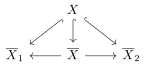
Namely, we can take \overline{X} to be a resolution of singularities of the closure of the diagonal image of X in \overline{X}_1\times\overline{X}_2. The identity map from \operatorname{H}^n(X,\mathbb{Z}) endowed with the mixed Hodge structure defined by \overline{X}_1 to \operatorname{H}^n(X,\mathbb{Z}) endowed with the mixed Hodge structure defined by \overline{X}_2 is thus the composite of two isomorphisms.
To finish the proof of (ii) and (iii), we note that every morphism f fits into a diagram of the form in (3.2.11.1): we choose compactifications \overline{X}'_1 and \overline{X}_2 of X_1 and X_2, then we take \overline{X}_1 to be a resolution of singularities of the closure of the image of X_1 in \overline{X}'_1\times\overline{X}_2.
The mixed Hodge structure of the cohomology of a smooth separated algebraic variety is the mixed Hodge structure from (iii) of (3.2.5).
With the above notation:
- The spectral sequence in (3.2.4.1) degenerates at E_2, i.e. the Leray spectral sequence for the inclusion j\colon X^*\hookrightarrow X degenerates at E_3 (i.e. E_3=E_\infty).
- The spectral sequence in (3.2.4.2) {}_FE_1^{pq} = \operatorname{H}^q(\overline{X},\Omega_{\overline{X}}^p\langle Y\rangle) \Rightarrow\operatorname{H}^{p+q}(X,\mathbb{C}) degenerates at E_1.
- The spectral sequence defined by the sheaf \Omega_X^p\langle Y\rangle, endowed with the filtration W \begin{aligned} E_1^{-n,k+n} &= \operatorname{H}^k(\overline{X},\operatorname{Gr}_n^W(\Omega_X^p\langle Y\rangle)) \\&\approx \operatorname{H}^k(\widetilde{Y}^n,\Omega_{\widetilde{Y}^n}^{p-n}(\varepsilon^n)) \Rightarrow\operatorname{H}^k(\overline{X},\Omega_X^p\langle Y\rangle) \end{aligned} degenerates at E_2.
Proof. Claim (i) is proven in (3.2.10).
Consider the four spectral sequences in (1.4.2), with respect to the bifiltered complex \Omega_{\overline{X}}^\bullet\langle Y\rangle. By (i), we have \sum_n \dim\operatorname{H}^n(X,\mathbb{C}) = \sum_{p,q} \dim {}_WE_2^{p,q}. The {}_WE_1^{n,k-n} pages are, for fixed n, the abutments of a spectral sequence that degenerates at E_1 (3.2.6) with initial pages E_1^{p,n,k-p-n} (with the notation of (1.4.12)) the initial pages of the spectral sequence in (iii). Since {}_Wd_1 is strictly compatible with the filtration F which is the abutment of this spectral sequence (3.2.7), and is (1.4.12) the abutment of a morphism between these spectral sequences, which starts with the differentials from (iii), we have \operatorname{Gr}_F^p({}_WE_2^{n,k-n}) \approx \operatorname{H}^\bullet(E_1^{p,n-1,k-n-p} \to E_1^{p,n,k-n-p} \to E_1^{p,n+1,k-n-p}) and \operatorname{Gr}_F^\bullet({}_WE_2^{\bullet\bullet}) is the sum of the pages E_2^{\bullet\bullet\bullet} of the spectral sequences in (iii). We thus have \sum_n \dim \operatorname{H}^n(X,\mathbb{C}) = \sum \dim E_2^{\bullet\bullet\bullet}. \tag{3.2.13.1} We also have \sum_n \dim \operatorname{H}^n(X,\mathbb{C}) \leqslant \dim {}_FE_1^{\bullet\bullet} with equality if and only if the spectral sequence in (ii) degenerates at E_1, and \sum \dim {}_FE_1^{\bullet\bullet} \leqslant \sum \dim E_2^{\bullet\bullet\bullet} with equality if and only if the spectral sequences in (iii) degenerate at E_2. Comparing with (3.2.13.1), we obtain (3.2.13).
Let \omega be a meromorphic differential p-form on \overline{X} that is holomorphic on X and presents at worst logarithmic poles along Y. Then the restriction \omega|X of \omega to X is closed, and if the cohomology class in \operatorname{H}^p(X,\mathbb{C}) defined by \omega is zero then \omega=0.
Proof. This is the particular case of (ii) of (3.2.13) where {}_FE_1^{p0}={}_FE_\infty^{p0}.
—
- If X is a smooth complete algebraic variety, then the mixed Hodge structure on \operatorname{H}^n(X,\mathbb{Z}) is the classical Hodge structure of weight n.
- The Hodge numbers h^{pq} of the mixed Hodge structure of \operatorname{H}^n(X,\mathbb{Z}) (with X algebraic and smooth) can only be zero for p\leqslant n, q\leqslant n, and p+q\geqslant n
Proof. Claim (i) is clear; to prove (ii), note that, if Y is the union of smooth divisors, then the rational Hodge structure \operatorname{Gr}_k^W(\operatorname{H}^n(X,\mathbb{Q})) is the quotient of a sub-object of a Hodge structure of weight n+k, namely \operatorname{H}^{n-k}(\widetilde{Y}^n,\mathbb{Q})\otimes\mathbb{Q}(-k).
Let X be a smooth separated scheme. We know that X admits smooth compactifications \overline{X} and that the subgroup of \operatorname{H}^n(X,\mathbb{Z}) given by the image of \operatorname{H}^n(\overline{X},\mathbb{Z}) is independent of the choice of \overline{X} (cf. (Grothendieck 1968, (9.1) to (9.4))).
Under the hypotheses of (3.2.16), the image of \operatorname{H}^n(\overline{X},\mathbb{Q}) in \operatorname{H}^n(X,\mathbb{Q}) is W_n(\operatorname{H}^n(X,\mathbb{Q})) (where W denotes the weight filtration (3.2.12)).
Proof. We can suppose that \overline{X}\setminus X is a normal crossing divisor. The claim then follows from the fact that W[-n] is the abutment of the Leray spectral sequence for the inclusion j\colon X\hookrightarrow\overline{X}.
Let f be a morphism from a smooth proper scheme Y to a smooth scheme X, with X admitting a smooth compactification j\colon X\hookrightarrow\overline{X}. Then the groups \operatorname{H}^n(X,\mathbb{Q}) and \operatorname{H}^n(\overline{X},\mathbb{Q}) have the same image in \operatorname{H}^n(Y,\mathbb{Q}).
Proof. Since f^* and (jf)^* are strictly compatible with the weight filtration ((iii) of (3.2.5)), it suffices to prove that \operatorname{Gr}^W(f^*) and \operatorname{Gr}^W(f^*j^*) have the same image in \operatorname{Gr}^W(\operatorname{H}^n(Y,\mathbb{Q})). By (3.2.17) and (3.2.15), \operatorname{Gr}_n^W(j^*) is an isomorphism, while \operatorname{Gr}_m^W(f^*)=0 for m\neq n since \operatorname{Gr}_m^W(\operatorname{H}^n(Y,\mathbb{Q}))=0 for m\neq n.
By (3.1.11) and (1.4.5), under the hypotheses of (3.2.5), the Hodge filtration on \operatorname{H}^n(X,\mathbb{C}) is the abutment of the hypercohomology spectral sequence of the complex j_*^m\Omega_{X^*}^\bullet endowed with the filtration given by the pole-order filtration (3.1.10): this spectral sequence coincides with (3.2.4.2).