5.1 Simplicial topological spaces
This section starts with some reminders for which we can refer to the homotopical seminar of Strasbourg, 1963/64.
We will us the following notation, where n,k\geqslant-1 are integers.
- \mathscr{A}^\circ = the opposite category of a category \mathscr{A}
- \underline{\operatorname{Hom}}(\mathscr{A},\mathscr{B}) = the category of functors from \mathscr{A} to \mathscr{B}.
- \Delta_n = the finite totally ordered set [0,n].
- \delta_i\colon\Delta_n\to\Delta_{n+1} = the increasing injection such that i\not\in\delta_i(\Delta_n) (for 0\leqslant i\leqslant n+1).
- s_i\colon\Delta_{n+1}\to\Delta_n = the increasing surjection such that s_i(i)=s_i(i+1) (for 0\leqslant i\leqslant n).
- \varepsilon\colon\Delta_{-1}\to\Delta_n = the unique map from \Delta_{-1} to \Delta_n.
- (\Delta^+) = the category whose objects are the \Delta_n (for n\geqslant-1) and whose morphisms are the increasing maps between the \Delta_n.
- (\Delta) = the full subcategory of (\Delta^+) whose objects are the \Delta_n (for n\geqslant0).
- (\Delta^+)_k = the full subcategory of (\Delta^+) whose objects are the \Delta_n (for k\geqslant n).
- (\Delta)_k = the full subcategory of (\Delta^+) whose objects are the \Delta_n (for k\geqslant n\geqslant0).
For any category \mathscr{C}, we define a simplicial object (resp. k-truncated simplicial object) of \mathscr{C} to be an object of \underline{\operatorname{Hom}}((\Delta)^0,\mathscr{C}) (resp. of \underline{\operatorname{Hom}}((\Delta)^0_k,\mathscr{C})). Similarly, a cosimplicial object (resp. k-truncated cosimplicial object) is an object of \underline{\operatorname{Hom}}((\Delta),\mathscr{C}) (resp. of \underline{\operatorname{Hom}}((\Delta)_k,\mathscr{C})).
For k\geqslant-1, the k-skeleton functor is the restriction functor \operatorname{sq}_k\colon \underline{\operatorname{Hom}}((\Delta)^0,\mathscr{C}) \to \underline{\operatorname{Hom}}((\Delta)_k^0,\mathscr{C}) and the k-coskeleton functor \operatorname{cosq}_k\colon \underline{\operatorname{Hom}}((\Delta)_k^0,\mathscr{C}) \to \underline{\operatorname{Hom}}((\Delta)^0,\mathscr{C}). is the right adjoint to \operatorname{sq}_k. Let Y be a simplicial object of \mathscr{C}. We also call the functor \operatorname{sq}_k\colon \underline{\operatorname{Hom}}((\Delta)^0,\mathscr{C})/Y \to \underline{\operatorname{Hom}}((\Delta)_k^0,\mathscr{C})/\operatorname{sq}_k(Y) the skeleton, and its right adjoint \operatorname{cosq}_k^Y\colon \underline{\operatorname{Hom}}((\Delta)_k^0,\mathscr{C})/\operatorname{sq}_k(Y) \to \underline{\operatorname{Hom}}((\Delta)^0,\mathscr{C})/Y is called the coskeleton with respect to Y.
The coskeleton functors exist if finite projective limits exist in \mathscr{C}; the relative coskeleton functors exist if fibred products do; we have \operatorname{cosq}_k^Y(X) = \operatorname{cosq}_k(X) \times_{\operatorname{cosq}_k\operatorname{sq}_k(Y)}Y.
If X_\bullet\colon(\Delta)^0\to\mathscr{C} is a simplicial object of \mathscr{C}, then we set
- X_n = X_\bullet(\Delta_n)
- \delta_i = X_\bullet(\delta_i\colon\Delta_n\to\Delta_{n+1})\colon X_{n+1}\to X_n
- s_i = X_\bullet(s_i\colon\Delta_{n+1}\to\Delta_n)\colon X_n\to X_{n+1}.
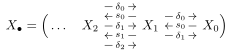
Let S\in\operatorname{Ob}\mathscr{C}. The constant simplicial object S_\bullet is the simplicial object for which S_n=S and \delta_i=s_i=\mathrm{Id}_S. A simplicial (resp. k-truncated simplicial) object of \mathscr{C} augmented over S is a morphism a\colon X_\bullet\to S_\bullet (resp. a\colon X_\bullet\to\operatorname{sq}_k(S_\bullet)). We identify such a simplicial object (resp. k-truncated simplicial object) augmented over S with the object X_\bullet^+ of \underline{\operatorname{Hom}}((\Delta^+)^0,\mathscr{C}) (resp. of \underline{\operatorname{Hom}}((\Delta^+)_k^0,\mathscr{C})) such that X_\bullet^+(\Delta_{-1})=S. We have that a_n=X_\bullet^+(\varepsilon\colon\Delta_{-1}\to\Delta_n). These objects will be denoted by notation of the form a\colon X_\bullet\to S. The relative coskeletons will be mostly used in this setting, and denoted \operatorname{cosq}_k^S or simply \operatorname{cosq}_k.
The coskeleton of the augmented 0-truncated simplicial object a_0\colon X\to S is the simplicial object augmented over S whose components are the cartesian powers of X in \mathscr{C}/S, i.e. \operatorname{cosq}_0(X\to S) = \big( ((X/S)^{\Delta_n})_{n\geqslant0} \to S \big).
Let u\colon X\to Y be a continuous map between topological spaces, and F a sheaf on X and G a sheaf on Y. The set \operatorname{Hom}_u(G,F) of
The data of a u-morphism f from G to F consists of the data of, for each pair of opens (U\subset X,V\subset Y) such that u(U)\subset V, a map f_{UV}\colon G(V)\to F(U); these maps must satisfy the condition
For U'\subset U\subset X and V'\subset V\subset Y such that u(U)\subset V and u(U')\subset V', the diagram
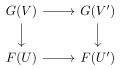
commutes.
A simplicial topological space is a simplicial object of the category whose objects are topological spaces and whose morphisms are continuous maps. }
A sheaf F^\bullet on a simplicial topological space X_\bullet consists of
- a family of sheaves F^n on the X_n;
- for all f\colon\Delta_n\to\Delta_m, an X_\bullet(f)-morphism F^\bullet(f) from F^n to F^m.
We further require that F^\bullet(f\circ g)=F^\bullet(f)\circ F^\bullet(g).
A morphism u from F^\bullet to G^\bullet is a family of morphisms u^n\colon F^n\to G^n such that, for all f\in\operatorname{Hom}_{(\Delta)}(\Delta_n,\Delta_m), we have that u^m\circ F^\bullet(f)=G^\bullet(f)\circ u^n.
For an open U of X_n, let F^\bullet(U)=F^n(U). For f\colon\Delta_n\to\Delta_m, U\subset X_n, and V\subset X_m such that X_\bullet(f)(V)\subset(U), let F^\bullet(f,V,U)\colon F^\bullet(U)\to F^\bullet(V) be the map induced by F^\bullet(f). We immediately see that the system of sets F^\bullet(U) (indexed by n\geqslant0 and U\subset X_n) and of maps F^\bullet(f,V,U) uniquely determines F^\bullet (cf. (5.1.5)). For such a system to come from a sheaf on X_\bullet, it is necessary and sufficient that:
- F^\bullet(fg,U,W)=F^\bullet(f,U,V)F^\bullet(g,V,W) whenever this makes sense;
- for any n, the F^\bullet(U) for U\subset X_n form a sheaf on X_n.
This shows that sheaves on X_\bullet can be interpreted as sheaves on a suitable site, and, in particular, form a topos (X_\bullet)^\sim. We freely use, for sheaves on X_\bullet, the modern terminology for sheaves on a site. With this in mind, a sheaf F^\bullet of abelian groups (resp. of rings, …) is a system of sheaves F^n of abelian groups (resp. of rings, …) on the X_n along with the morphisms F^\bullet(f).
—
Let X_\bullet be a simplicial analytic space. The structure sheaves \mathcal{O}_{X_n} form a sheaf of rings on X_\bullet.
Let X_\bullet be a simplicial analytic space augmented over S. The sheaves \Omega_{X_n/S}^1 form a sheaf of \mathcal{O}-modules on X_\bullet. Its i-th exterior power is the sheaf of \mathcal{O}-modules (\Omega_{X_n/S}^i)_{n\geqslant0} denoted \Omega_{X_\bullet{/}S}^i. The de Rham complexes (\Omega_{X_n/S}^\bullet)_{n\geqslant0} form a complex of sheaves on X_\bullet.
Let F^\bullet be a sheaf of abelian groups on X_\bullet. The canonical flasque Godement resolutions \mathscr{C}^\bullet(F^n) form a complex of sheaves on X_\bullet that is a resolution of F^\bullet.
Let S be a topological space. Sheaves F^\bullet on the constant simplicial space S_\bullet can be identified with cosimplicial sheaves on S^\bullet. In particular, an abelian sheaf F^\bullet on S_\bullet defines a chain complex (F^n,d=\sum_i(-1)^i\delta_i). A complex K of abelian sheaves on S_\bullet defines a double complex (K^{n,m}) that we again denote by K (here m is the cosimplicial degree) and whose associated simple complex \mathrm{s}{K} is (\mathrm{s}{K})^n = \bigoplus_{p+q=n} K^{pq} \tag{5.1.9.1} with differential given by \mathrm{d}(x^{pq}) = \mathrm{d}_K(x^{pq}) + (-1)^p\sum_i(-1)^i\delta_i x^{pq}. \tag{5.1.9.2} We denote by L the second filtration of \mathrm{s}{K}, i.e. L^r(\mathrm{s}{K}) = \bigoplus_{q\geqslant r} K^{pq}. \tag{5.1.9.3}
Let u\colon X_\bullet\to Y_\bullet be a morphism of simplicial topological spaces, with components u_n\colon X_n\to Y_n. If G (resp. F) is a sheaf on Y_\bullet (resp. on X_\bullet), then (u_n^*G^n)_{n\geqslant0} (resp. ({u_n}_*F^n)_{n\geqslant0}) is a sheaf on X_\bullet (resp. on Y_\bullet); we denote it by u^*G (resp. by u_*F). The functors u^* and u_* are adjoint to one another; they are the inverse image and direct image morphisms of topos morphism u\colon(X_\bullet)^\sim\to(Y_\bullet)^\sim.
Let a\colon X_\bullet\to S be an augmented simplicial topological space. If F is a sheaf on S, then a^*F=(a_n^*F)_{n\geqslant0} “is” a sheaf on X_\bullet. The functor a^* has a right adjoint a_*\colon F^\bullet \mapsto \operatorname{Ker}\big( {a_0}_* F^0 \,\overset{\delta_0^*}{\underset{\delta_1^*}{\rightrightarrows}}\, {a_1}_* F^1 \big). \tag{5.1.11.1} The functors a^* and a_* are the inverse image and direct image morphisms of topos morphism a\colon(X_\bullet)^\sim\to(S)^\sim.
Let S_\bullet be the constant simplicial space associated to S, and a_\bullet\colon X_\bullet\to S_\bullet the morphism defined by a. For an abelian sheaf F^\bullet on X_\bullet, we can identify {a_\bullet}_*F^\bullet with a cosimplicial sheaf on S ((iv) of (5.1.9)). For a complex K of abelian sheaves on X_\bullet, if K^{pq} is the degree p component of the restriction of K to X_q, then the components of the simple complex associated to the double complex defined by {a_\bullet}_*K are (\mathrm{s}{a_\bullet}_*K)^n = \bigoplus_{p+q=n} {a_q}_* K^{pq}. \tag{5.1.12.1}
The spectral sequence defined by the filtration L (5.1.9.3) of \mathrm{s}{a_\bullet}_*K can be written as E_1^{pq} = \operatorname{H}^q({a_p}_*(K|X^p)) \Rightarrow\operatorname{H}^{p+q}(\mathrm{s}{a_\bullet}_*K). \tag{5.1.12.2}
Let S=P^t (the topological space consisting of a single point). We see that, for a sheaf F^\bullet on X_\bullet, the \Gamma(X_n,F^n) are the components of a cosimplicial set \Gamma^\bullet(X_\bullet,F^\bullet). The functor \Gamma (of global sections) is the functor \Gamma\colon F^\bullet \mapsto \operatorname{Ker}\big( \Gamma(X_0,F^0) \rightrightarrows \Gamma(X_1,F^1) \big). \tag{5.1.13.1}
If K is a complex of abelian sheaves, we denote by \Gamma^\bullet(X_\bullet,K) the chain complex whose components are the cosimplicial abelian groups \Gamma^\bullet(X_\bullet,K^n), and by \mathrm{s}\Gamma^\bullet(X_\bullet,K) the associated simple complex.