4.1 The fixed set theorem
Let S be a smooth separated scheme, and f\colon X\to S a smooth proper morphism.
- In rational cohomology, the Leray spectral sequence E_2^{pq} = \operatorname{H}^p(S,\mathrm{R}^qf_*\mathbb{Q}) \Rightarrow\operatorname{H}^{p+q}(X,\mathbb{Q}) degenerates (E_2=E_\infty).
- If \overline{X} is a non-singular compactification of X, then the canonical morphism \operatorname{H}^n(\overline{X},\mathbb{Q}) \to \operatorname{H}^0(S,\mathrm{R}^nf_*\mathbb{Q}) is surjective.
Proof. For f smooth and projective, claim (i) is proven in (Deligne 1968); the proof is rewritten in a more readable manner in (Griffiths 1970); it does not use the smoothness of S.
Let us fix f, and prove that (i)\implies(ii). We can reduce to the case where S is non-empty and connected. If s\in S is a point, then the local system \mathrm{R}^nf_*\mathbb{Q} is entirely described by its fibre (\mathrm{R}^nf_*\mathbb{Q})_s at s and the action of the fundamental group \pi=\pi_1(S,s) on this fibre. We have \operatorname{H}^0(S,\mathrm{R}^n f_*\mathbb{Q}) \xrightarrow{\sim}[(\mathrm{R}^n f_*\mathbb{Q})_s]^\pi. If X_s=f^{-1}(s), then the composite arrow \operatorname{H}^0(S,\mathrm{R}^n f_*\mathbb{Q}) \to (\mathrm{R}^n f_*\mathbb{Q}) \approx \operatorname{H}^n(X_s,\mathbb{Q}) is thus injective. Consider the arrows \operatorname{H}^n(\overline{X},\mathbb{Q}) \xrightarrow{a} \operatorname{H}^n(X,\mathbb{Q}) \xrightarrow{b} \operatorname{H}^0(S,\mathrm{R}^n f_*\mathbb{Q}) \xhookrightarrow{c} \operatorname{H}^n(X_s,\mathbb{Q}). The arrows cb and cba have the same image, by (3.2.18). The arrow b is an “edge homomorphism” of the Leray spectral sequence, and is thus surjective by hypothesis. Since c is injective, b and ba have the same image, and ba is surjective.
This proves (ii) for f projective. From this we will deduce the general case. We can again reduce to the case where S is non-empty and connected.
By Chow’s lemma and the resolution of singularities, there exists a quasi-projective smooth scheme X' and a projective birational morphism p\colon X'\to X. There thus exists (by Bertini, or Sard) a non-empty Zariski open S_1 of S such that X'_1=(fp)^{-1}(S_1) is smooth over S_1. Finally, let X_1=f^{-1}(S_1), let \overline{X} be a smooth compactification of X, and let \overline{X}'_1 be a smooth compactification of X'_1 that dominates \overline{X}.
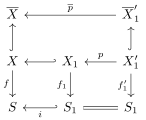
If s\in S_1, then the morphism i_*\colon\pi_1(S_1,s)\to\pi_1(S,s) is surjective, since the topological codimension of S\setminus S_1 is \geqslant2. We thus have \operatorname{H}^0(S,\mathrm{R}^n f_*\mathbb{Q}) \xrightarrow{\sim}\operatorname{H}^0(S_1,\mathrm{R}^n {f_1}_*\mathbb{Q}) and it suffices to prove that \operatorname{H}^n(\overline{X},\mathbb{Q}) \to \operatorname{H}^0(S_1,\mathrm{R}^n {f_1}_*\mathbb{Q}) is surjective.
The vertical arrows in the diagram \begin{CD} \operatorname{H}^n(\overline{X},\mathbb{Q}) @>>> \operatorname{H}^n(X_1,\mathbb{Q}) @>>> \operatorname{H}^0(S_1,\mathrm{R}^n{f_1}_*\mathbb{Q}) \\@VV{\overline{p}^*}V @VV{p^*}V @VV{p^*}V \\\operatorname{H}^n(\overline{X}'_1,\mathbb{Q}) @>>> \operatorname{H}^n(X'_1,\mathbb{Q}) @>>> \operatorname{H}^0(S_1,\mathrm{R}{f'_1}_*\mathbb{Q}) \end{CD} admit left inverses given by the Gysin morphisms \overline{p}_!, p_!, and p_! (respectively), defined by Poincaré duality as the transposes of the arrows analogous to the above but in cohomology with proper support. Furthermore, the diagram \begin{CD} \operatorname{H}^n(\overline{X},\mathbb{Q}) @>{u}>> \operatorname{H}^0(S_1,\mathrm{R}^n{f_1}_*\mathbb{Q}) \\@A{\overline{p}_!}AA @AA{p_!}A \\\operatorname{H}^n(\overline{X}',\mathbb{Q}) @>>{v}> \operatorname{H}^0(S_1,\mathrm{R}^n{f'_1}_*\mathbb{Q}) \end{CD} commutes. The arrow u is thus a direct factor of the arrow v. Since v is surjective (because f'_1 is projective), so too is u.
We now prove (i) in the general case. We can reduce to the case where f is of pure relative dimension n. Let f\times f be the projection of X\times_S X to S.
Let \delta be the image of the cohomology class of the diagonal of X\times_S X in \operatorname{H}^0(S,\mathrm{R}^n(f\times f)_*,\mathbb{Q}). We have, by Künneth, \mathrm{R}^n(f\times f)_*\mathbb{Q} = \sum_{p+q=n} (\mathrm{R}^p f_*\mathbb{Q}\otimes\mathrm{R}^q f_*\mathbb{Q}). We denote by \delta'_{pq} (for p+q=n) the components of \delta in this decomposition, and by \delta_{pq} the classes in \operatorname{H}^n(X\times_S X) given by the images of the \delta'_{pq}.
The \delta_{pq} define, in the derived category \mathrm{D}^+(S), homomorphisms \delta_p\colon \mathrm{R}f_*\mathbb{Q} \to \mathrm{R}f_*\mathbb{Q} such that \operatorname{\mathscr{H}}^q(\delta_p) is zero for p\neq q, and is the identity for p=q. By (Deligne 1968), we thus have \mathrm{R}f_*\mathbb{Q} \approx \sum_p \mathrm{R}^p f_*\mathbb{Q}[-p] \tag{4.1.1.1} in \mathrm{D}^+(S), and the Leray spectral sequence degenerates.
Let f\colon X\to S be a proper smooth morphism, with S reduced, connected, and separated. Let (\mathrm{R}^n f_*\mathbb{Q})_0 be the largest constant local system on \mathrm{R}^n f_*\mathbb{Q}, with fibre \operatorname{H}^0(S,\mathrm{R}^n f_*\mathbb{Q}). Then, for each s\in S, (\mathrm{R}^n f_*\mathbb{Q})_s^0 is a Hodge sub-structure of (\mathrm{R}^n f_*\mathbb{Q})\simeq\operatorname{H}^n(X_s,\mathbb{Q}), and the induced Hodge structure on \operatorname{H}^0(S,\mathrm{R}^n f_*\mathbb{Q}) is independent of s.
Proof. Let s\in S, and let X_s=f^{-1}(s). If S is smooth, and if \overline{X} is a smooth compactification of X, then, by (4.1.1), the subspace (\mathrm{R}^n f_*\mathbb{Q})_s^0 of (\mathrm{R}^n f_*\mathbb{Q})_s is the image of \operatorname{H}^n(\overline{X},\mathbb{Q}). Since the restriction map \operatorname{H}^n(\overline{X},\mathbb{Q}) \to \operatorname{H}^n(X_s,\mathbb{Q}) is a morphism of Hodge structures, its image is a Hodge sub-structure, and the induced Hodge structure on \operatorname{H}^0(S,\mathrm{R}^n f_*\mathbb{Q}), given by the quotient of that on \operatorname{H}^n(\overline{X},\mathbb{Q}), is independent of s.
In the general case, (4.1.2) also implies that, if a is a global section of \mathrm{R}^n f_*\mathbb{C}, then its components a^{p,q} of degree (p,q), which are a priori only continuous sections of the complex bundle defined by \mathrm{R}^n f_*\mathbb{C}, are in fact locally constant, i.e. are sections of \mathrm{R}^n f_*\mathbb{C}. This is the case because a^{p,q} is continuous, and further locally constant on the (dense) open subset of smooth points of S, by the above.
In the case where S is compact, a generalisation of (4.1.2) is proven by analytic methods in (Griffiths 1970).
As a corollary to (4.1.2), we note:
(cf. [Griffiths (1970)). Let f\colon X\to S be a proper smooth morphism, as in (4.1.2). If a global section a of \mathrm{R}^n f_*\mathbb{C} is of Hodge degree (p,q) at a point, then a is everywhere of degree (p,q). In particular, if n=2 and if a is, at some point s, the cohomology class of a divisor of X_s, then a is everywhere the cohomology class of a divisor, and, if S is smooth, is even defined by a divisor D on X.
(cf. (Grothendieck 1966)). Let S be a reduced connected scheme of finite type over \mathbb{C}, and let f_1\colon X_1\to S and f_2\colon X_2\to S be abelian schemes over S. If a morphism u\colon\mathrm{R}^1{f_2}_*\mathbb{Z}\to\mathrm{R}^1{f_1}_*\mathbb{Z} comes from a morphism \widetilde{u}_s\colon(X_1)_s\to(X_2)_s of abelian varieties at some point s\in S, then u comes from a (unique) morphism of abelian schemes \widetilde{u}\colon X_1\to X_2.
(cf. (Katz 1971)). Let S be a smooth connected scheme, s\in S a point, f\colon X\to S a proper smooth morphism, and P a direct factor of the local system \mathrm{R}^i f_*\mathbb{Q}, which is pointwise a Hodge sub-structure. Then the following conditions are equivalent:
- The Hodge structure of P is locally constant.
- The representation P_s of \pi_1(S,s) factors through a finite quotient of \pi_1(S,s).
- There exists a finite non-empty étale covering u\colon S'\to S such that u^*P is a constant family of Hodge structures.