4.3 Supplement to [D1968]
In the footnote to (5.4) in (Deligne 1968), I claim without proof that:
Let X be a smooth proper scheme over \mathbb{C}. If a C^\infty form \alpha on X satisfies \mathrm{d}'\alpha=\mathrm{d}''\alpha=0 and is cohomologous to zero, then there exists \beta such that \alpha=\mathrm{d}'\mathrm{d}''\beta.
Proof. Here is the proof. As in loc. cit., we can reduce to the case where \alpha is bihomogeneous, with bidegree (p,q). Since the spectral sequence of the double complex \operatorname{H}^0(X,\Omega^{pq}) degenerates, the exterior differential d is strictly compatible with the filtration by the first degree p (1.3.2). If a\sim0, then there thus exists a form \beta_1 such that \mathrm{d}\beta_1=\alpha and such that the components \beta_1^{p'q'} of \beta_1 are zero for p'<p.
By complex conjugation, there similarly exists \beta_2 such that \mathrm{d}\beta_2=\alpha and such that the components \beta_2^{p'q'} of \beta_2 are zero for q'<q. We have \mathrm{d}(\beta_1-\beta_2)=0.
Let \gamma be a form satisfying \mathrm{d}'\gamma=\mathrm{d}''\gamma=0 in the cohomology class of \beta_1-\beta_2 (loc. cit.). Let \gamma_1 (resp. \gamma_2) be the sum of the components of \gamma of degree (p',q') for p'\geqslant p (resp. q'\geqslant q). If we set \beta'_1=\beta_1-\gamma_1 and \beta'_2=\beta_2+\gamma_2, then we still have that \mathrm{d}\beta'_1=\mathrm{d}\beta'_2=\alpha; furthermore, \beta'_1-\beta'_2=\beta_1-\beta_2-\gamma is cohomologous to zero: there exists \delta such that \mathrm{d}\delta = \beta'_1 - \beta'_2. Let \delta_1 (resp. \delta_2) be the sum of the components of \delta of degree (p',q') for p'<p-1 (resp. q'>q-1); let \beta be the component of \delta of degree (p-1,q-1).
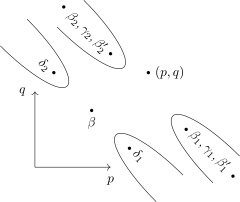
We have that \beta'_2 =\mathrm{d}\delta_2 + \mathrm{d}''\beta and \begin{aligned} \alpha = \mathrm{d}\beta'_2 &= \mathrm{d}\mathrm{d}\delta_2 + \mathrm{d}\mathrm{d}''\beta \\&= \mathrm{d}'\mathrm{d}''\beta. \end{aligned}