1.1 Filtered objects
Let \mathscr{A} be an abelian category.
We will be considering \mathbb{Z}-filtrations, finite, in general, on the objects of \mathscr{A}:
A decreasing (resp. increasing) filtration F of an object A of \mathscr{A} is a family (F^n(A))_{n\in\mathbb{Z}} (resp. (F_n(A))_{n\in\mathbb{Z}}) of sub-objects of A satisfying \forall n,m \quad n\leqslant m \implies F^m(A)\subset F^n(A) (resp. n\leqslant m\implies F_n(A)\subset F_m(A)).
A filtered object is an object endowed with a filtration. When there is no chance of confusion, we often denote by the same letter filtrations on different objects of \mathscr{A}.
If F is a decreasing (resp. increasing) filtration on A, then we set F^\infty(A)=0 and F^{-\infty}(A)=A (resp. F_{-\infty}(A)=0 and F_\infty(A)=A).
The shifted filtrations of a decreasing filtration W are defined by W[n]^p(A) = W^{n+p}(A) for n\in\mathbb{Z}.
If R is a decreasing (resp. increasing) filtration of A, then the F_n(A)=F^{-n}(A) (resp the F^n(A)=F_{-n}(A)) form an increasing (resp. decreasing) filtration of A. This allows us in principal to consider only decreasing filtrations; unless otherwise explicitly mentioned, when we say “filtration” we always mean “decreasing filtration”.
A filtration F of A is said to be finite if there exist n and m such that F^n(A)=A and F^m(A)=0.
A morphism from a filtered object (A,F) to a filtered object (B,F) is a morphism f from A to B that satisfies f(F^n(A))\subset F^n(B) for all n\in\mathbb{Z}.
Filtered objects (resp. finite filtered objects) of \mathscr{A} form an additive category in which inductive limits and finite projective limits exist (and thus kernels, cokernels, images, and coimages of a morphism).
A morphism f\colon(A,F)\to(B,F) is said to be strict, or strictly compatible with the filtrations, if the canonical arrows from \operatorname{Coim}(f) to \operatorname{Im}(f) is an isomorphism of filtered objects (cf. (1.1.11)).
Let (-)^\circ be the contravariant identity functor from \mathscr{A} to the dual category \mathscr{A}^\circ. If (A,F) is a filtered object of \mathscr{A}, then the (A/F^n(A))^\circ can be identified with sub-objects of A^\circ. The dual filtration on A^\circ is defined by F^n(A^\circ) = (A/F^{1-n})^\circ.
The double dual of (A,F) can be identified with (A,F). This construction identifies the dual of the category of filtered objects of \mathscr{A} with the category of filtered objects of \mathscr{A}^\circ.
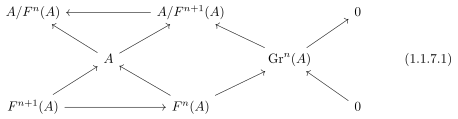
If (A,F) is a filtered object of \mathscr{A}, then its associated graded is the object of \mathscr{A}^\mathbb{Z} defined by \operatorname{Gr}^n(A) = F^n(A)/F^{n+1}(A). The convention (1.1.6) is justified by the simple formula \operatorname{Gr}^n(A^\circ) = \operatorname{Gr}^{-n}(A)^\circ which follows from the self-dual diagram
Let (A,F) be a filtered object, and j\colon X\hookrightarrow A a sub-object of A. The filtration induced by F (or simply the induced filtration) on X is the unique filtration on X such that j is strictly compatible with the filtrations; we have F^n(X) = j^{-1}(F^n(A)) = X\cap F^n(A).
Dually, the quotient filtration on A/X (the unique filtration such that p\colon A\to A/X is strictly compatible with the filtrations) is given by F^n(A/X) = p(F^n(A)) \cong (X+F^n(A))/X \cong F^n(A)/(X\cap F^n(A)).
If X and Y are sub-objects of A, with X\subset Y, then on Y/X\xrightarrow{\sim}\operatorname{Ker}(A/X\to A/Y) the quotient filtration of Y agrees with that induced by that of A/X. In the diagram
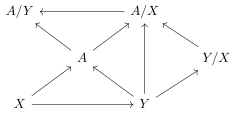
We call the filtration (1.1.9) on Y/X the filtration induced by that of A (or simply the induced filtration). By (1.1.9), its definition is self-dual.
In particular, if \Sigma\colon A\xrightarrow{f}B\xrightarrow{G}C is a 0-sequence, and if B is filtered, then \operatorname{H}(\Sigma)=\operatorname{Ker}(g)/\operatorname{Im}(f)=\operatorname{Ker}(\operatorname{Coker}(f)\to\operatorname{Coim}(g)) is endowed with a canonical induced filtration.
The reader can show that:
Let f\colon(A,F)\to(B,F) be a morphism of filtered objects with finite filtrations. For f to be strict, it is necessary and sufficient that the sequence 0 \to \operatorname{Gr}(\operatorname{Ker}(f)) \to \operatorname{Gr}(A) \to \operatorname{Gr}(B) \to \operatorname{Gr}(\operatorname{Coker}(f)) \to 0 be exact.
Let \sigma\colon(A,F)\to(B,F)\to(C,F) be a 0-sequence sequence of strict morphisms. We then have \operatorname{H}(\operatorname{Gr}(\Sigma)) \cong \operatorname{Gr}(\operatorname{H}(\Sigma)) canonically. In particular, if \Sigma is exact in \mathscr{A}, then \operatorname{Gr}(\Sigma) is exact in \mathscr{A}^\mathbb{Z}.
In a category of modules, to say that a morphism f\colon(A,F)\to(B,F) is strict implies that every b\in B of filtration \geqslant n (i.e. b\in F^n(B)) that is in the image of A is already in the image of F^n(A): f(F^n(A)) = f(A)\cap F^n(B).
If \otimes\colon\mathscr{A}_1\times\ldots\times\mathscr{A}_n\to\mathscr{B} is a multiadditive right-exact functor, and if A_i is an object of finite filtration of \mathscr{A}_i (for 1\leqslant i\leqslant n), then we define a filtration on \bigotimes_{i=1}^n A_i by F^k(\bigotimes_{i=1}^n A_i) = \sum_{\sum k_i=k} \operatorname{Im}(\bigotimes_{i=1}^n F^{k_i}(A_i)\to\bigotimes_{i=1}^n A_i) (a sum of sub-objects).
Dually, if H is left-exact, then we set F^k(H(A_i)) = \bigcap_{\sum k_i=k} \operatorname{Ker}(H(A_i)\to H(A_i/F^{k_i}(A_i))).
If H is exact, then the two definitions are equivalent.
We extend these definitions to contravariant functors in certain variables by (1.1.6). In particular, for the left-exact functor \operatorname{Hom}, we set F^k(\operatorname{Hom}(A,B)) = \{f\colon A\to B \mid f(F^n(A))\subset F^{n+k}(B)\,\,\forall n\}. We thus have \operatorname{Hom}((A,F),(B,F)) = F^0(\operatorname{Hom}(A,B)).
Under the above hypotheses, we have obvious morphisms \begin{aligned} \bigotimes_{i=1}^n \operatorname{Gr}(A_i) &\to \operatorname{Gr}(\bigotimes_{i=1}^n A_i) \\\operatorname{Gr}H(A_i) &\to H(\operatorname{Gr}(A_i)). \end{aligned} If H is exact, then these are isomorphisms and inverse to one another.
These constructions are compatible with composition of functors, in a sense whose details we leave to the reader.