4.4 Homomorphisms of abelian schemes
We intend to show how, in some cases, we can remove from (4.1.3.2) the assumption of algebraicity at a point.
Let f\colon X\to S be a smooth proper morphism; we denote by \mathrm{R}_i f_*\mathbb{Z} the local system on S^\mathrm{an} whose homology is the fibres of f. At each point s\in S, (\mathrm{R}_i f_*\mathbb{Z})_s\simeq\operatorname{H}_i(X_s,\mathbb{Z}) is endowed with a Hodge structure of weight -i, dual to the Hodge structure on \operatorname{H}^i(X_s,\mathbb{Z}). This structure varies continuously with s\in S.
If f\colon X\to S is an abelian scheme, then the exponential defines an exact sequence 0 \to \mathrm{R}_1f_*\mathbb{Z} \to \operatorname{Lie}(X) \to X \to 0 of sheaves on S^\mathrm{an}, and the Hodge filtration is the short exact sequence 0 \to \operatorname{Ker}(\alpha) \to \mathrm{R}_1f_*\mathbb{Z}\otimes\mathcal{O} \xrightarrow{\alpha} \operatorname{Lie}(X) \to 0.
It is known that:
Let S be a smooth scheme of finite type over \mathbb{C}. The construction of (4.4.2) establishes an equivalence of categories between
- the category of abelian schemes over S; and
- the category of polarisable continuous families of Hodge structures H of type (-1,0)+(0,-1) on S such that H_\mathbb{Z} is torsion free and the Hodge filtration varies holomorphically on S.
Proof. The essential surjectivity of the functor that goes from (a) to (b) follows from Borel (unpublished); the full faithfulness follows from the fact that, for two abelian schemes X_1 and X_2 over S, the S-scheme \underline{\operatorname{Hom}}_S(X_1,X_2) is unramified over S, and thus has the same algebraic and holomorphic sections.
Let Z be a commutative field, H a simple central algebra over Z, and * a Z-linear anti-automorphism of H. After extension of scalars, we have H\simeq\operatorname{End}(V) for some vector space V over Z, and * is then the transposition with respect to a bilinear form \Phi on V, unique up to a factor. Suppose that * is involutive; the forms \Phi(X,Y) and \Phi(Y,X) are then proportional, i.e. \Phi(X,Y)=\lambda\Phi(Y,X) for some \lambda^2=1. We set \varepsilon_*=\lambda. If [H:Z]=d^2, then \operatorname{Tr}(*\colon H\to H) = \varepsilon_*\cdot d.
Every Z-linear automorphism C of H is interior: Cx=cxc^{-1}. If C is involutive and commutes with *, then the elements c^2 and cc^* are central, so that c^*=\lambda c with \lambda central. Since c^{**}=c, we have that \lambda^2=1. We set \varepsilon_C=\lambda.
We easily see that the involution C\circ * satisfies \varepsilon_{C\circ *} = \varepsilon_C\cdot\varepsilon_*.
Let X be a simple abelian variety over a field K, and let H be the field \operatorname{End}_K(X)\otimes\mathbb{Q}. Every polarisation of X defines a positive involution * of H, i.e. \operatorname{Tr}(hh^*) > 0 \quad\text{if }h\neq0. If Z_0 is the *-invariant subfield of the centre Z of H, then Z_0 is completely real and we are in one of the following cases:
- Z=Z_0 and, for every real place \rho of Z, H\otimes_\rho\mathbb{R} is an algebra of matrices over \mathbb{R}, and \varepsilon_*=1.
- Z=Z_0 and, for every real place \rho of Z, H\otimes_\rho\mathbb{R} is an algebra of matrices over \mathbb{H}, and \varepsilon_*=-1.
- Z is a completely imaginary quadratic extension of Z_0.
Let f_i\colon X_i\to S (for i=1,2) be an abelian scheme over a smooth scheme S. The free abelian group \operatorname{Hom}(\mathrm{R}_1{f_1}_*\mathbb{Z},\mathrm{R}_1{f_2}_*\mathbb{Z}) \simeq \Gamma(S,\underline{\operatorname{Hom}}(\mathrm{R}_1{f_1}_*\mathbb{Z},\mathrm{R}_1{f_2}_*\mathbb{Z})) is then endowed with a Hodge structure of weight 0 (4.2.8). Further, by (2.1.11.1) and (4.4.3), the group \operatorname{Hom}_S(X_1,X_2) is the degree (0,0) component of this group.
Let S be a non-empty, connected, smooth scheme, with generic point \eta, and let f\colon X\to S be an abelian scheme over S. The centre Z of H=\operatorname{End}(\mathrm{R}_1f_*\mathbb{Z}) is then of degree (0,0) (4.2.8), and thus contained in \operatorname{End}_S(X)\simeq\operatorname{End}_{k(\eta)}(X_\eta).
A polarisation of X defines an involution * of H. The restriction of this to \operatorname{End}_S(X) is positive, so that Z is the product of completely real fields or quadratic imaginary extensions of completely real fields.
Denote by C the actions of i\in S(\mathbb{R}) on H_\mathbb{R}=H\otimes\mathbb{R} and on the (\mathrm{R}_1f_*\mathbb{R})_s for s\in S. On H_\mathbb{R}, C^2=1, and C commutes with *; on (\mathrm{R}_1f_*\mathbb{R})_s, C^2=-1. If \psi is the alternating form on \mathrm{R}_1f_*\mathbb{Z} with integer values induced by the polarisation of X, then \psi(hx,Cy) = \psi(x,h^*Cy) = \psi(x,C\cdot C(h^*)\cdot y). We thus deduce that \operatorname{Tr}(h\cdot C(h^*)) > 0 \quad\text{for }h\neq0. \tag{4.4.7.1}
Now suppose that X_\eta is simple, so that Z is a field. Let \rho\colon Z\to\mathbb{C} be a complex embedding. Then the algebra H_\rho = H\otimes_{Z,\rho}\mathbb{C} is an algebra of matrices and a bigraded direct factor of H_\mathbb{C}=H\otimes_\mathbb{Q}\mathbb{C}. Pick an isomorphism H_\rho \simeq \operatorname{End}(V_\rho). \tag{4.4.8.1}
From the fact that the infinitesimal generators of S act on H_\rho, by derivations, which are necessarily interior, we deduce that V_\rho admits a bigrading, unique up to translation, such that (4.4.8.1) is a bigraded isomorphism. Let (\mathrm{R}_1f_*\mathbb{C})_\rho be the bigraded local system (\mathrm{R}_1f_*\mathbb{C})\otimes_{Z\otimes\mathbb{C},\rho}\mathbb{C} which is a direct factor of \mathrm{R}_1f_*\mathbb{C}. Denote by T_\rho the local system T_\rho = \operatorname{Hom}_{H_\rho}(V_\rho,(\mathrm{R}_1f_*\mathbb{C})_\rho).
We have the bigraded isomorphism V_\rho\otimes_\mathbb{C}T_\rho \xrightarrow{\sim}(\mathrm{R}_1f_*\mathbb{C})_\rho. \tag{4.4.8.2}
Since (\mathrm{R}_1f_*\mathbb{C})_\rho is of degree (-1,0)+(0,-1), one of the following conditions is satisfied:
- V_\rho is bihomogeneous;
- T_\rho is bihomogeneous.
It is clear that condition (a) (resp. (b)) is simultaneously satisfied by \rho and \overline{\rho}. If condition (a) is satisfied at each place, then H is of degree (0,0). If condition (b) is satisfied at each place, then the Hodge structure on \mathrm{R}_1f_*\mathbb{Q} is locally constant.
Now suppose that Z is completely real. For each real embedding \varphi of Z, we set \varepsilon_{H,\varphi}=+1 if H\otimes_{Z,\varphi}\mathbb{R} is an algebra of matrices; we set \varepsilon_{H,\varphi}=-1 otherwise. If a complex embedding \rho induces a real embedding \varphi, then we set \varepsilon_{H\rho}=\varepsilon_{H\varphi}.
Let \rho\colon Z\to\mathbb{C} factor through \varphi\colon Z\to\mathbb{R}. Complex conjugation on H_\rho is induced by an antilinear automorphism \sigma_1 of V_\rho, unique up to real scalar, with scalar square. Since \sigma_1 commutes with \sigma_1^2, \sigma_1^2 is real and, by normalising \sigma_1, we can assume that \sigma_1^2=\pm1. We then have that \sigma_1^2 = \varepsilon_{H\rho}. \tag{4.4.9.1}
The complex conjugation automorphism on (\mathrm{R}_1f_*\mathbb{C})_\rho =((\mathrm{R}_1f_*\mathbb{Q})\otimes_{Z,\varphi}\mathbb{R})\otimes_\mathbb{R}\mathbb{C} is “compatible” with (4.4.8.2) and can be written as \sigma = \sigma_1\otimes\sigma_2. Since \sigma^2=1, we have, by (4.4.9.1), that \sigma_1^2 = \sigma_2^2 = \varepsilon_{H\rho}. \tag{4.4.9.2}
Let \Phi be a polarisation form on \mathrm{R}_1f_*\mathbb{Z}. This form is necessarily of the form \Phi = \operatorname{Tr}_{Z/\mathbb{Q}}(\psi) where \psi is an alternating Z-bilinear form on \mathrm{R}_1f_*\mathbb{Q}.
Let \psi_\rho be the form induced on V_\rho\otimes_\mathbb{C}T_\rho. The alternating form \psi_\rho is invariant under \pi_1(S,s). Since T_\rho is irreducible, we can write \psi_\rho as \psi_\rho = A_\rho\otimes B_\rho \tag{4.4.9.3} with A_\rho on V_\rho, and B_\rho on T_\rho invariant under \pi_1(S,s).
Since T_\rho is irreducible, B_\rho is either symmetric or alternating. Since \psi_\rho is alternating, A_\rho is either symmetric or alternating. Since the T_\rho are conjugate to one another, whether we are in one case or the other does not depend on \rho. We set A_\rho(X,Y) = \varepsilon_V A_\rho(Y,X) \tag{4.4.9.4} B_\rho(X,Y) = \varepsilon_T B_\rho(Y,X). \tag{4.4.9.5} We thus have \varepsilon_V\varepsilon_T = -1 \tag{4.4.9.6} and it is clear by (4.4.4) that if * is the involution of H induced by \psi, then \varepsilon_* = \varepsilon_V. \tag{4.4.9.7}
In case (a) (resp. (b)) of (4.4.8), we normalise the bigradings so that V_\rho (resp. T_\rho) is of bidegree (0,0). We then have, for non-zero x\in V_\rho and non-zero y\in T_\rho, the two cases:
- A_\rho(x,\sigma_1 x)B_\rho(y,C\sigma_2 y) > 0;
- A_\rho(x,C\sigma_1 x)B_\rho(y,\sigma_2 y) > 0.
By normalising A_\rho and B_\rho (of which only their tensor product is given), we can suppose, in each respective case, that
- A_\rho(x,\sigma_1x)>0 and B_\rho(y,C\sigma_2y)>0;
- A_\rho(x,C\sigma_1x)>0 and B_\rho(y,\sigma_2y).
Furthermore, A_\rho and B_\rho, just like \Phi, are invariant under the compact sub-torus \operatorname{Ker}(N) of S, and in particular under C. In case (a), we have that 0 < A_\rho(\sigma_1x,\sigma_1\sigma_1x) = \varepsilon_V\cdot\varepsilon_{H,\rho}A_\rho(x,\sigma_1x) whence \varepsilon_V\cdot\varepsilon_{H\rho}=1. Similarly, in case (b), we see that \varepsilon_T\cdot\varepsilon_{H\rho}=1.
For \varepsilon_T=\varepsilon_{H\rho}, we are in case (b); for \varepsilon_T=-\varepsilon_{H\rho}, we are in case (a).
Let S be a non-empty, connected, smooth scheme, with generic point \eta, and let f\colon X\to S be an abelian scheme over S. Let H=\operatorname{End}(\mathbb{R}_1f_*\mathbb{Q}), and let Z be the centre of H. Suppose that
- X_\eta is simple over k(\eta).
- X does not become constant on any finite covering of S.
- One of the following conditions is satisfied (cf. (4.4.5)):
- Z is imaginary quadratic;
- Z is completely real, and for each real embedding \varphi\colon Z\to\mathbb{R}, H\otimes_{Z,\varphi}\mathbb{R} is an algebra of matrices over \mathbb{R};
- Z is completely real, and for each real embedding \varphi\colon Z\to\mathbb{R}, H\otimes_{Z,\varphi}\mathbb{R} is an algebra of matrices over \mathbb{H}.
Then \operatorname{End}(X) \xrightarrow{\sim}\operatorname{End}(\mathrm{R}_1f_*\mathbb{Z}).
Proof. We will show that we are either in case (a) or case (b) of (4.4.8), for every place of Z simultaneously. (4.4.8) is evident under the hypothesis (c.1), and follows from (4.4.10) under the hypotheses (c.2) or (c.3), since not only \varepsilon_T, but also \varepsilon_{H\rho}, is then independent of \rho.
Condition (b) of (4.4.8) cannot be satisfied at every place of Z, since the Hodge structure would then be locally constant, which (by (4.1.3.3) and (4.4.3)) contradicts (b). Condition (a) is thus satisfied at each place of Z, and so H is of degree (0,0) ((4.4.8)). Taking (4.4.3) into account, this finishes the proof.
Let f\colon X\to S be an abelian scheme over a smooth scheme S. Then the following conditions are equivalent:
- For every abelian scheme Y\to S, we have \operatorname{Hom}_S(X,Y) \xrightarrow{\sim}\operatorname{Hom}_S(\mathrm{R}_1f_*\mathbb{Z},\mathrm{R}_1g_*\mathbb{Z}).
- Condition (i) is satisfied for X=Y, and the centre Z of \operatorname{End}_S(X)\otimes\mathbb{Q} does not admit any complex place \rho\colon Z\to\mathbb{C} such that the direct factor \mathrm{R}_1f_*\mathbb{Q}\otimes_{Z,\rho}\mathbb{C} of \mathrm{R}_1f_*\mathbb{C} is of pure Hodge degree (-1,0).
Proof. We can reduce to the case where S is non-empty and connected, with generic point \eta, and where X_\eta is a simple abelian variety over k(\eta). If (i) or (ii) is satisfied, then D=\operatorname{End}(X_\eta)\otimes\mathbb{Q} is a field, and, for s\in S, (\mathrm{R}_1f_*\mathbb{Q})_s is an irreducible representation of \pi_1(S,s). }
To prove that (ii) \implies (i), we can suppose Y_\eta to be simple, and (\mathrm{R}_1g_*\mathbb{Q})_s to be isotypic of type (\mathrm{R}_1f_*\mathbb{Q})_s. We then have an isomorphism of continuous families of Hodge \mathbb{Q}-structures (with D of degree (0,0)) \mathrm{R}_1g_*\mathbb{Q} \approx \mathrm{R}_1f_*\mathbb{Q}\otimes_D\operatorname{Hom}(\mathrm{R}_1f_*\mathbb{Q},\mathrm{R}_1g_*\mathbb{Q}).
We have that D\otimes\mathbb{C}\simeq\mathbb{M}_n(Z\otimes\mathbb{C}). If e\in D\otimes\mathbb{C} is sent by such an isomorphism to the idempotent e_{11}, then we again have an isomorphism of bigraded vector spaces (\mathrm{R}_1g_*\mathbb{C})_s \approx (\mathrm{R}_1f_*\mathbb{C})_s\otimes_{Z\otimes\mathbb{C}}e(\operatorname{Hom}(\mathrm{R}_1f_*\mathbb{C},\mathrm{R}_1g_*\mathbb{C})).
If condition (ii) is satisfied, and if e(\operatorname{Hom}(\mathrm{R}_1f_*\mathbb{C},\mathrm{R}_1g_*\mathbb{C})) is not of pure degree (0,0), then (\mathrm{R}_1g_*\mathbb{C})_s cannot be of pure degree (-1,0)+(0,-1), which is a contradiction. We thus deduce that \operatorname{Hom}(\mathrm{R}_1f_*\mathbb{Z},\mathrm{R}_1g_*\mathbb{Z}) is of pure degree (0,0), and (i) then follows by (4.4.3) and (2.1.11.1).
Let Z be a completely imaginary quadratic extension of a completely real number field Z^0. If Z\otimes\mathbb{R}\approx\mathbb{C}\oplus\ldots\oplus\mathbb{C}, then we define an action by homotheties of S on Z\otimes\mathbb{R} by sending s\in S(\mathbb{R})\simeq\mathbb{C}^* to (s^2\cdot N(s)^{-1},1,\ldots,1). The pair consisting of Z and this action of S on Z\otimes\mathbb{R} is a polarisable Hodge structure Z_\rho of degree (-1,1)+(0,0)+(1,-1) that depends on Z and the chose place \rho\colon Z\to\mathbb{C}.
Let X be an abelian scheme over S such that X_\eta is simple. If the centre Z of \operatorname{End}(\mathrm{R}_1f_*\mathbb{Q}) is not completely real, then it is a completely imaginary quadratic extension of a completely real number field. If the second hypothesis of (ii) is not satisfied, then the direct factor \mathrm{R}_1f_*\mathbb{Q}\otimes_Z Z_\rho of the continuous family of polarisable Hodge structures \mathrm{R}_1f_*\mathbb{Q}\otimes_\mathbb{Q}Z_\rho is of pure degree (-1,0)+(0,-1).
By (4.4.3), the choice of an integer lattice in \mathrm{R}_1f_*\mathbb{Q}\otimes_Z Z_\rho defines an abelian scheme g\colon Y\to S, and \operatorname{Hom}(\mathrm{R}_1f_*\mathbb{Q},\mathrm{R}_1g_*\mathbb{Q}) is not of pure degree (0,0), which contradicts (i).
Let S be a smooth connected scheme with generic point \eta, and let f\colon X\to S be an abelian scheme over S of relative dimension g\leqslant3. Suppose that, on any finite étale covering of S, X does not admit a constant abelian subscheme. Then, for every abelian scheme g\colon Y\to S, we have \begin{aligned} \operatorname{Hom}(X,Y) &\xrightarrow{\sim}\operatorname{Hom}(\mathrm{R}_1f_*\mathbb{Z},\mathrm{R}_1g_*\mathbb{Z}) \\\operatorname{Hom}(Y,X) &\xrightarrow{\sim}\operatorname{Hom}(\mathrm{R}_1g_*\mathbb{Z},\mathrm{R}_1f_*\mathbb{Z}). \end{aligned}
Proof. By duality, it suffices to prove the first claim. We can also suppose X_\eta to be simple. We will show that X satisfies one of the conditions of (c) in (4.4.11).
Set H=\mathbb{M}_c(D), with D a skew field of rank b^2 over its centre Z, which we know to be either completely real or completely imaginary. If we set a=[Z:\mathbb{Q}], then we have ab^2c \mathbin{\vert} 2g \leqslant 6. \tag{4.4.13.1}
If Z is completely imaginary, and not imaginary quadratic, then we must have a=2g=4. For s\in S, the centraliser of Z acting on (\mathrm{R}_1f_*\mathbb{Q})_s is thus commutative, and so the action of \pi_1(S,s) is abelian, and thus factors through a finite group ((iii.b) of (4.2.8) or (4.2.9)). This is a contradiction ((4.1.3.3) and (4.4.3)).
With the notation of (4.4.8), we can also note that the T_\rho are then of rank 1, and so condition (b) of (4.4.8) is satisfied at each place, and the Hodge structure is locally constant.
If Z is completely real, and if conditions (c.1) and (c.2) are not satisfied, then a\geqslant2 and b\geqslant2, which is a contradiction.
We will show that X satisfies the conditions of (4.4.12). If Z is imaginary quadratic, and if there exists \rho\colon Z\to\mathbb{C} such that \mathrm{R}_1f_*\mathbb{Q}\otimes_{Z,\rho}\mathbb{C} is of pure Hodge type (-1,0), then the Hodge structure on \mathrm{R}_1f_*\mathbb{Q} is locally constant, which is a contradiction. This proves (4.4.13).
Let f\colon X\to S be a polarised abelian scheme of dimension g over a smooth connected base S. For s\in S, the fundamental group \pi_1(S,s) acts on the fibre \operatorname{H}^1(X_s,\mathbb{Z}) of \mathrm{R}_1f_*\mathbb{Z} over s. The polarisation of X defines an alternating form on \operatorname{H}^1(X_s,\mathbb{Z}), with values in \mathbb{Z}(-1), that is non-degenerate over \mathbb{Q}, and the action of \pi_1(S,s) respects this form. Consider the hypothesis:
The morphism defined by X from S to one of the irreducible components of the corresponding scheme of modules of polarised abelian varieties is a dominant morphism.
The following result was suggested to me by J.-P. Serre.
Let S be a smooth connected scheme, and f\colon X\to S a polarised abelian scheme over S that satisfies (4.4.14.1). Then, for every abelian scheme g\colon Y\to S, we have \operatorname{Hom}(X,Y) \xrightarrow{\sim}\operatorname{Hom}(\mathrm{R}_1f_*\mathbb{Z},\mathrm{R}_1g_*\mathbb{Z}).
Proof. Let s\in S. By (4.4.11) and (4.4.12), it suffices to show that the representation of \pi_1(S,s) on (\mathrm{R}_1f_*\mathbb{Q})_s is absolutely irreducible, so that H=\mathbb{Q}. This follows from the following lemma.
If X satisfies (4.4.14.1), then the image of \pi_1(S,s) in the group of symplectic automorphisms of \operatorname{H}^1(X_s,\mathbb{Z}) is of finite index.
Proof. Let n be an integer. Replacing S by a surjective étale covering, defined by a finite-index subgroup of \pi_1(S,s), if necessary, we can assume that the local system {}_nX=\operatorname{Ker}(n\cdot\mathrm{Id}\colon X\to X) is trivial on S. Replacing X by an isogenous abelian scheme, we can then assume that X is polarised in the principal series. Suppose that n\geqslant 3.
The abelian scheme X then defines a dominant morphism x from the S to the scheme of “Jacobi” modules M_n of polarised abelian schemes in the principal series endowed with a symplectic isomorphism between {}_nX and (\mathbb{Z}/n)^{2g}; furthermore, X is an inverse image under x of the universal abelian scheme on M_n. We know that \pi_1(M_n,x(s)) is sent isomorphically to the subgroup of \operatorname{Sp}(\operatorname{H}^1(X_s,\mathbb{Z})) given by the kernel of the reduction \operatorname{mod}{n} map. It thus remains to show the following lemma.
Let p\colon S\to M be a dominant morphism of smooth connected schemes. The subgroup p(\pi_1(S,s)) of \pi_1(M,p(s)) is then of finite index.
Proof. Let t be a closed point of the generic fibre of p, and let T' be its closure in S. There exists a dense Zariski open U of M such that T=p^{-1}(U)\cap T' is an étale covering of U.
We lose no generality by assuming that s\in T. In the diagram
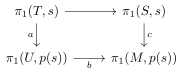
the image of the arrow a is of finite index, since T is a finite étale covering, and the arrow b is surjective, since M\setminus U is of real codimension \geqslant2. The image of the arrow c is thus of finite index.