1.3 The two-filtrations lemma
Let K be a differential complex of objects of \mathscr{A}, endowed with a filtration F. The filtration is said to be biregular if it induces a finite filtration on each component of K.
We recall the definition of the terms E_r^{pq}(K,F), or simply E_r^{pq}, of the spectral sequence defined by F. We set Z_r^{pq} = \operatorname{Ker}(d\colon F^p(K^{p+q})\to F^{p+q+1}/F^{p+r}(K^{p+q+1})) and dually we define B_r^{pq} by the formula K^{p+q}/B_r^{pq} = \operatorname{Coker}(d\colon F^{p-r+1}(K^{p+q+1})\to K^{p+q}/F^{p+1}(K^{p+q})). These formulas still make sense for r=\infty.
We note that the use here of the notation B_r^{pq} is different to that of Godement (Godement 1958).
We have, by definition: E_r^{pq} = \operatorname{Im}(Z_r^{pq}\to K^{p+q}/B_r^{pq}) \tag{1.3.1.1} = Z_r^{pq}/(B_r^{pq}\cap Z_r^{pq}) \tag{1.3.1.2} = \operatorname{Ker}(K^{p+q}/B_r^{pq}\to K^{p+q}/(Z_r^{pq}+B_r^{pq})). \tag{1.3.1.3} We can thus write \begin{aligned} B_r^{p\bullet}\cap Z_r^{p\bullet} &\coloneqq (dF^{p-r+1}+F^{p+1}) \cap (d^{-1}F^{p+r}\cap F^p) \\&= (dF^{p-r+1}\cap F^p) + (F^{p+1}\cap d^{-1}F^{p+r}) \end{aligned} \tag{1.3.1.4} since dF^{p-r+1}\subset d^{-1}F^{p+r} and F^{p+1}\subset F^p.
For r<\infty, the E_r form a complex graded by the degree p-r(p+q), and E_{r+1} can be expressed as the cohomology of this complex:
E_{r+1}^{pq} = \operatorname{H}(E_r^{p-r,q+r-1} \xrightarrow{d_r} E_r^{pq} \xrightarrow{d_r} E_r^{p+r,q-r+1}). \tag{1.3.1.5}
For r=0, we have E_0^{\bullet\bullet} = \operatorname{Gr}_F^\bullet(K^\bullet). \tag{1.3.1.6}
Let K be a complex endowed with a biregular filtration F. The following conditions are equivalent:
- The spectral sequence defined by F degenerates (E_1=E_\infty).
- The morphisms d\colon K^i\to K^{i+1} are strictly compatible with the filtrations.
Proof. We will prove this in the case where \mathscr{A} is a category of modules. For fixed p and q, the hypothesis that the arrows d_r with domains E_r^{pq} be zero for r\geqslant1 implies that, if x\in F^p(K^{p+q}) satisfies dx\in F^{p+1}(K^{p+q+1}), then there exists y\in K^{p+q} such that dy=0 and such that x and y have the same image in E_1^{pq}. Modifying y by a boundary, and setting z=x-y, we then have \forall x\in F^p(K^{p+q}) \left[ dx\in F^{p+1}(K^{p+q+1}) \implies \exists z\text{ s.t. } z\in F^{p+1}(K^{p+q}) \text{ and } dz=dx \right] or, in other words, F^{p+1}(K^{p+q+1}) \cap dF^p(K^{p+q}) = dF^{p+1}(K^{p+q}). \tag{1}
If this condition is satisfied for arbitrary p and q, then by induction on r we have F^{p+r} \cap dF^p = dF^{p+r} which, for large p+r, can be written as F^p \cap dK = dF^p. \tag{2}
Claim (2) trivially implies (1), and is equivalent to (ii), which proves the proposition.
If (K,F) is a filtered complex, we denote by \operatorname{Dec}(K) the complex K endowed with the shifted filtration \operatorname{Dec}(F)^p K^n = Z_1^{p+n,-p}.
This filtration is compatible with the differentials: \begin{aligned} dZ_1^{p+n,-p} &\subset F^{p+n+1}(K^{n+1}) \cap \operatorname{Ker}(d) \\&\subset Z_\infty^{p+n+1,-p} \\&\subset Z_1^{p+n+1,-p}. \end{aligned}
Since \begin{aligned} Z_1^{p+1+n,-p-1} &\subset F^{p+1+n}(K^n) \\&\subset B_1^{p+n,-p} \\&\subset Z_1^{p+n,-p} \end{aligned} \tag{1.3.3.1} the evident arrow from Z_1^{p+n,-p}/Z_1^{p+1+n,-p-1} to Z_1^{p+n,-p}/B_1^{p+n,-p} is a morphism u\colon E_0^{p,n-p}(\operatorname{Dec}(K)) \to E_1^{p+n,-p}(K). \tag{1.3.3.2}
—
- The morphisms in (1.3.3.2) form a morphism of graded complexes from E_0(\operatorname{Dec}(K)) to E_1(K).
- This morphism induces an isomorphism on cohomology.
- This morphism induces step-by-step (via (1.3.1.5)) isomorphisms of graded complexes E_r(\operatorname{Dec}(K))\xrightarrow{\sim}E_{r+1}(K) (for r\geqslant1).
Proof.
Let F' be the filtration on K defined by {F'}^p(K^n) = \operatorname{Dec}(F)^{p-n}(K^n) = Z_1^{p,n-p}. We trivially have isomorphisms E_r^{p,n-p}(\operatorname{Dec}(K)) = E_{r+1}^{p+n,-p}(K,F') \tag{1.3.4.1} that are compatible with the d_r and with (1.3.1.5). The map u comes from (1.3.4.1) and from the identity map (K,F') \to (K,F). This proves (i), and it remains to show that, for r\geqslant2, E_r^{pq}(K,F') \xrightarrow{\sim}E_r^{pq}(K,F). We have \begin{aligned} Z_r^{pq}(K,F') &= Z_r^{pq}(K,F) \qquad\text{for }r\geqslant1 \\Z_r^{pq}(K,F') \cap B_r^{pq}(K,F') &= Z_r^{pq}(K,F) \cap B_r^{pq}(K,F) \qquad\text{for }r\geqslant2 \end{aligned} and we can then apply (1.3.1.2).
The construction in (1.3.3) is not self-dual. The dual construction consists of defining \operatorname{Dec}^\bullet(F)^pK^n = B_1^{p+n-1,-p+1}. We then have morphisms E_0^{p,n-p}(\operatorname{Dec}(K)) \to E_1^{p+n,p}(K) \to E_0^{p,n-p}(\operatorname{Dec}^\bullet(K)) and, for r\geqslant1, isomorphisms E_r^{p,n-p}(\operatorname{Dec}(K)) \xrightarrow{\sim}E_{r+1}^{p+n,p}(K) \xrightarrow{\sim}E_{r}^{p,n-p}(\operatorname{Dec}^\bullet(K)).
Recall that a morphism of complexes is said to be a quasi-isomorphism if it induces an isomorphism on cohomology.
—
- A morphism f\colon(K,F)\to(K',F') of filtered complexes with biregular filtrations is a filtered quasi-isomorphism if \operatorname{Gr}_F(f) is a quasi-isomorphism, i.e. if the E_1^{pq}(f) are isomorphisms.
- A morphism f\colon(K,F,W)\to(K,F',W') of biregular bifiltered complexes is a bifiltered quasi-isomorphism if \operatorname{Gr}_F\operatorname{Gr}_W(f) is a quasi-isomorphism.
Let K be a differential complex of objects of \mathscr{A}, endowed with two filtrations F and W. Let E_r^{pq} be the spectral sequence defined by W. The filtration F induces on E_r^{pq} various filtrations, which we will compare.
Equation (1.3.1.2) identifies E_r^{pq} with a quotient of a sub-object of K^{p+q}. The E_r^{pq} term is thusly given by endowing with a filtration F_d induced by F, called the first direct filtration.
Dually, (1.3.1.3) identifies E_r^{pq} with a sub-object of a quotient of K^{p+q}, whence a new filtration F_{d^*} induced by F, called the second direct filtration.
On E_0 and E_1, we have F_d=F_{d^*}.
Proof. For r=0,1, we have B_r^{pq}\subset Z_r^{pq}, and we apply (1.1.9).
Equation (1.3.1.5) identifies E_{r+1}^{pq} with a quotient of a sub-object of E_r^{pq}. We define the recurrent filtration F_r on the E_r^{pq} by the conditions
- On E_0^{pq}, F_r=F_d=F_{d^*}.
- On E_{r+1}^{pq}, the recurrent filtration is that induced by the recurrent filtration of E_r^{pq}.
Definitions (1.3.8) and (1.3.9) still make sense for r=\infty. If the filtration on K is biregular, then the direct filtrations on E_\infty^{pq} coincide with those on E_r^{pq}=E_\infty^{pq} for large enough r, and we define the recurrent filtration on E_\infty^{pq} as agreeing with that on E_r^{pq} for large enough r.
The filtrations F and W each induce a filtration on H^\bullet(K), and E_\infty^{\bullet\bullet}=\operatorname{Gr}_W^\bullet(\operatorname{H}^\bullet(K)). The filtration F on \operatorname{H}^\bullet(K) then induces on E_\infty^{pq} a new filtration.
—
- For the first direct filtration, the morphisms d_r are compatible with the filtrations. If E_{r+1}^{pq} is considered as a quotient of a sub-object of E_r^{pq}, then the first direct filtration on E_{r+1}^{pq} is finer than the filtration F' induced by the first direct filtration on E_r^{pq}Y we have F_d(E_{r+1}^{pq})\subset F'(E_{r+1}^{pq}).
- Dually, the morphisms d_r are compatible with the second direct filtration, and the second direct filtration on E_{r+1}^{pq} is less fine than the filtration induced by that of E_r^{pq}.
- F_d(E_r^{pq})\subset F_r(E_r^{pq})\subset F_{d^*}(E_r^{pq}).
- On E_\infty^{pq}, the filtration induced by the filtration F of \operatorname{H}^\bullet(K) is finer than the first direct filtration and less fine than the second.
Proof. Claim (i) is evident, (ii) is its dual, and (iii) follows by induction. The first claim of (iv) is easy to verify, and the second is its dual.
We denote by \operatorname{Dec}(K) (resp. \operatorname{Dec}^\bullet(K)) the complex K endowed with the filtrations \operatorname{Dec}(W) and F (resp. \operatorname{Dec}^\bullet(W) and F).
It is clear by (1.3.4.1) that the isomorphism in (1.3.4) sends the first direct filtration on E_r(\operatorname{Dec}(K)) to the second direct filtration on E_{r+1}(K) (for r\geqslant1). The dual isomorphism (1.3.5) sends the second direct filtration on E_r(\operatorname{Dec}^\bullet(K)) to the second direct filtration on E_{r+1}(K).
If the filtration F is biregular, and if, on the \operatorname{Gr}_W^p(K), the morphisms d are strictly compatible with the filtration induced by F, then
- The morphism of graded complexes filtered by F u\colon \operatorname{Gr}_{\operatorname{Dec}(W)}(K) \to E_1(K,W) is a filtered quasi-isomorphism.
- Dually, the morphism in u\colon E_1(K,W) \to \operatorname{Gr}_{\operatorname{Dec}^\bullet(W)}(K) is a filtered quasi-isomorphism.
Proof. It suffices, by duality, to prove (i).
By (1.3.3) and (1.3.4), the complex E_1(K,W) filtered by F is a quotient of the filtered complex \operatorname{Gr}_{\operatorname{Dec}(W)}(K). Let U be the filtered complex given by the kernel, which is acyclic by (ii) of (1.3.4). The long exact sequence in cohomology associated to the exact sequence of complexes 0 \to \operatorname{Gr}_F(U) \to \operatorname{Gr}_F(\operatorname{Gr}_{\operatorname{Dec}(W)}(K)) \to \operatorname{Gr}_F(E_1(K,W)) \to 0 shows that u is a filtered quasi-isomorphism if and only if \operatorname{Gr}_F(U) is an acyclic complex. By (1.3.2), and since U is acyclic, this reduces to asking that the differentials of U be strictly compatible with the filtration F. From (1.3.3.1) we obtain that U is the sum over p of the complexes (U^p)^n = B_1^{p+n,-p}/Z_1^{p+1+n,-p-1} endowed with the filtration induced by F.
Each differential d of each of the complexes U^p fits into a commutative diagram of filtered objects of the following type, where, for simplicity, we have omitted the total or complementary degree:
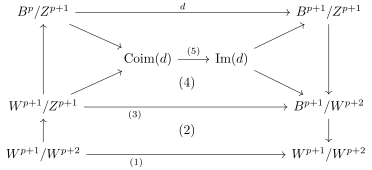
By hypothesis, the morphism (1) is strict. Since the square (2) is exactly the canonical decomposition of (1), the arrow (3) is a filtered isomorphism. The arrows of the trapezium (4) are isomorphisms; they are thus filtered isomorphisms, since (3) is a filtered isomorphism. The fact that (5) is a filtered isomorphism implies that d is strict. This proves the lemma.
Let K be a complex endowed with two filtrations, W and F, with the filtration F biregular. Let r_0\geqslant0 be an integer, and suppose that, for 0\leqslant r<r_0, the differentials of the graded complex E_r(K,W) are strictly compatible with the filtration F. Then, for r\leqslant r_0+1, F_d=F_r=F_{d^*} on E_r^{pq}.
Proof. We will prove the theorem by induction on r_0. For r_0=0, the hypothesis is empty, and we apply (1.3.10) and (iii) of (1.3.13). For r_0\geqslant1, by the inductive hypothesis, we have F_d=F_r=F_{d^*} on E_r^{pq} for r\leqslant r_0.
By (1.3.15), the morphism u\colon E_0(\operatorname{Dec}(K))\to E_1(K) is a filtered quasi-isomorphism. It thus induces a filtered isomorphism from \operatorname{H}^\bullet(\operatorname{Dec}(K)) to \operatorname{H}^\bullet(E_1(K)): u\colon (E_1(\operatorname{Dec}(K)),F_r) \xrightarrow{\sim}(E_2(K),F_r). Step-by-step, we thus deduce that the canonical isomorphism from E_s(\operatorname{Dec}(K)) to E_{s+1} (for s\geqslant1) is a filtered isomorphism for the recurrent filtration.
On E_1(\operatorname{Dec}(K)), F_r=F_d ((1.3.10)), and we already know ((1.3.14)) that u' is a filtered isomorphism u'\colon (E_1(\operatorname{Dec}(K)),F_d) \xrightarrow{\sim}(E_2(K),F_d).
On E_2(K), we thus have F_d=F_r. This, combined with the dual result, proves the theorem for r_0=1.
Suppose that r_0\geqslant2. Then the arrows d_1 of E_1(K) are strictly compatible with the filtrations, and thus so too are the arrows d_0 of E_0(\operatorname{Dec}(K)) (indeed, u induces an isomorphism of spectral sequences, and we apply the criterion from (1.3.2).
For 0<s<r_0-1, the isomorphism (E_s(\operatorname{Dec}(K)),F_r)\cong(E_{s+1}(K),F_r) shows that the d_s are strictly compatible with the recurrent filtrations.
By the induction hypothesis, we thus have F_d=F_r on E_s(\operatorname{Dec}(K)) for s\leqslant s_0. The isomorphism (E_s(\operatorname{Dec}(K)),F_d)\cong(E_{s+1}(K),F_d) ((1.3.13)) then shows that F_d=F_r on E_r(K) for r\leqslant r_0+1. This, combined with the dual result, proves the theorem.
Under the general hypotheses of (1.3.16), suppose that, for all r, the differentials d_r are strictly compatible with the recurrent filtrations on the E_r. Then, on E_\infty, the filtrations F_d, F_r, and F_{d^*} agree, and coincide with the filtration induced by the filtration F of \operatorname{H}^\bullet(K).