6.2 Construction of hypercovers
Let X_\bullet be a simplicial set. Denote by D(\Delta_n,\Delta_M) the set of increasing surjective maps from \Delta_n to \Delta_m (degeneracy operators), and set N(X_n) = X_n\setminus\bigcup_{{s\in D(\Delta_n,\Delta_{n-1})}}s(X_{n-1}). \tag{6.2.1.1}
Recall that, for all n, the map \coprod s \colon \coprod_{\mathclap{\substack{m\leqslant n,\\s\in D(\Delta_n,\Delta_m)}}} N(X_m) \to X_n \tag{6.2.1.2} is bijective.
We say that a simplicial topological space is s-split if the maps in (6.2.1.2) are homeomorphisms.
Let X_\bullet be a k-truncated simplicial set. For n\leqslant k, we again define N(X_n) by (6.2.1.1), and then (6.2.1.2) is a bijection. We say that a k-truncated simplicial topological space is s-split if (6.2.1.2) is a homeomorphism for n\leqslant k.
For an s-split (n+1)-truncated topological simplicial space X augmented over S, let \alpha(X) be the triple consisting of \operatorname{sq}_n(X), NX_{n+1}, and the evident map from NX_{n+1} to (\operatorname{cosq}\operatorname{sq}_n X){n+1}}.
This triple \alpha(X)=(Y,N,\beta) satisfies the following:
(*) Y is an s-split n-truncated simplicial topological space augmented over S, and \beta is a continuous map from N to (\operatorname{cosq}Y){n+1}}.
(SGA 4, V bis, (5.1.3)). Let (Y,N,\beta) satisfy (*) above.
Up to unique isomorphism, there exists exactly one s-split (n+1)-truncated topological space X augmented over S such that \alpha(X)\simeq(Y,N,\beta).
It is equivalent to give either f\colon X\to Z or:
- a morphism f'\colon Y\to\operatorname{sq}_n(Z); and
- a morphism f''\colon N\to Z_{n+1}, such that the diagram \begin{CD} N @>\beta>> (\operatorname{cosq}Y)_{n+1} \\@V{f''}VV @VV{f'}V \\Z_{n+1} @>>> (\operatorname{cosq}\operatorname{sq}_n Z)_{n+1} \end{CD} commutes.
Proof. (Saint-Donat 1972, 5.1.3).
This proposition also applies to simplicial objects in other categories \mathscr{C} apart from that of topological spaces; it suffices that \mathscr{C} satisfy the following:
Finite projective limits exist in \mathbb{C}. Finite projective sums exist in \mathbb{C}, and they are disjoint and universal.
(6.2.4) allows us to construct, by induction, proper hypercovers of S.
(n=0). We take f_0\colon X_0\to S, proper and surjective. Then \{X_0\} is a 0-truncated proper hypercover of S (5.3.8), and it is s-split.
(n=1). We take f_1\colon N_1\to\operatorname{cosq}(\{X_0\})_1, i.e. f_1\colon N_1\to X_0\times_S X_0. Applying (6.2.4), we associate to f_1 the s-split 1-truncated augmented simplicial topological space {}_1X_\bullet = \left( N_1{\textstyle\coprod} X_0 \xleftarrow[\to]{\to} X_0 \to S \right). Suppose f_1 to be chosen such that f'_1 \colon N_1{\textstyle\coprod} X_0\to X_0\times_S X_0 is proper and surjective (for example, if f_1 is proper and surjective). Then {}_1X_\bullet is an s-split 1-truncated proper hypercover of S.
…
(n=k+1). Assume that we have already constructed an s-split k-truncated proper hypercover {}_kX_\bullet\to S. We take f_{k+1}\colon N_{k+1}\to(\operatorname{cosq}({}_kX_\bullet))_{k+1} and, applying (6.2.4), we associate to f_{k+1} an s-split (k+1)-truncated augmented semi-simplicial space {}_{k+1}X_\bullet. Suppose that f_{k+1} is such that f'_{k+1} \colon {}_{k+1}X_{k+1} \to \operatorname{cosq}({}_kX_\bullet)_{k+1} is proper and surjective (for example, if f_{k+1} is proper and surjective). Then {}_{k+1}X_\bullet is an s-split (k+1)-truncated proper hypercover of S.
…
(n=\infty). The {}_kX_\bullet thus constructed are the successive skeletons of an s-split proper hypercover of S.
We say that a simplicial scheme X_\bullet over \mathbb{C} is smooth if the X_n are smooth; it is said to be proper if the X_n are compact. A normal crossing divisor D_\bullet of X_\bullet, assumed to be smooth, is a family D_n\subset X_n of normal crossing divisors (3.1.2) such that the U_n=X_n\setminus D_n form a simplicial subscheme U_\bullet of X_\bullet. This definition is justified by the following lemma.
If D_\bullet is a normal crossing divisor of X_\bullet, then the logarithmic de Rham complexes (\Omega_{X_n}^\bullet(\log D_n))_{n\geqslant0}, endowed with the weight filtration (3.1.5), form a filtered complex on X_\bullet.
Proof. This follows from (ii) of (3.1.3).
We denote the complex (\Omega_{X_n}^\bullet(\log D_n))_{n\geqslant0} by \Omega_{X_\bullet}^\bullet(\log D_\bullet).
Using (6.2.5), we can show that, for every separated scheme S over \mathbb{C}, there exists:
- a simplicial scheme X_\bullet over \mathbb{C}, smooth and proper, that we can take to be s-split;
- a normal crossing divisor D_\bullet of X_\bullet; we set U_\bullet=X_\bullet\setminus D_\bullet;
- an augmentation a\colon U_\bullet\to S that realises U_\bullet^\mathrm{an} as a proper hypercover of S^\mathrm{an}.
Furthermore, any two such systems are covered by a third, and a morphism u\colon S\to T can be covered by a morphism
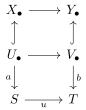
of such systems (see (Saint-Donat 1972)).