7.2 Supplements to the two-filtrations lemma
In this section, we give a new proof of the two filtrations lemma (1.3.16) and some supplements.
Let (K,F,W) be a bounded-below bifiltered complex with objects in an abelian category \mathscr{A}, with F assumed to be biregular.
We say that (K,F,W) is F-splitable if the filtered complex (K,W) can be written as a sum of filtered complexes (K,W) = \bigoplus_{n\in\mathbb{Z}} (K_n,W_n) with F^nK = \bigoplus_{n'\geqslant n} K_{n'}.
Let r_0\geqslant0 be an integer or +\infty. The following condition was considered in (1.3.16) and (1.3.17):
For every non-negative integer r<r_0, the differentials d_r of the graded complex E_r(K,W) are strictly compatible with the recurrent filtration defined by F.
It is clear that, if (K,F,W) is F-splitable, then (7.2.2) is satisfied for r_0=\infty. Conversely, it seems that if (7.2.2) is satisfied for r_0=\infty, then everything is as if the functor \operatorname{Gr}_F were exact. For example, we will show that the \operatorname{Gr}_F of the spectral sequence E(K,W) can then be identified with the spectral sequence E(\operatorname{Gr}_FK,W), and that the spectral sequence E(K,F) degenerates (E_1=E_\infty).
We immediately deduce from the definition (1.3.8) that the first direct filtration of E_r(K,W) is the filtration F_d of E_r(K,W) by the images F_d^p(E_r(K,W)) = \operatorname{Im}\big(E_r(F^pK,W) \to E_r(K,W)\big). Dually, the second direct filtration (1.3.9) of E_r(K,W) is the filtration F_{d^*} of E_r(K,W) by the kernels F_{d^*}^p(E_r(K,W)) = \operatorname{Ker}\big(E_r(K,W) \to E_r(K/F^pK,W)\big). The recurrent filtration F_{\mathrm{rec}} of E_r(K,W) is intermediary between these two filtrations ((iii) of (1.3.13)).
Suppose that (K,F,W) satisfies (7.2.2) for some r_0\geqslant0. Then
- (F^aK/F^bK,F,W) also satisfies (7.2.2) for r_0.
- For r\leqslant r_0, the sequence 0 \to E_r(F^pK,W) \to E_r(K,W) \to E_r(K/F^pK,W) \to 0 is exact; for r=r_0+1, the sequence E_r(F^pK,W) \to E_r(K,W) \to E_r(K/F^pK,W) is exact. In particular, for r\leqslant r_0+1, the two direct filtrations and the recurrent filtration of E_r(K,W) agree.
Proof. Fix an integer p. We will prove the claim
(*)_r If r\leqslant r_0, then E_r(F^pK,W) injects into E_r(K,W); if r\leqslant r_0+1, its image is F_\mathrm{rec}(E_r(K,W)).
by induction on r.
The claim (*)_0 is always true. Assume (*)_r, and let us prove (*)_{r+1}. We can suppose that 0\leqslant r\leqslant r_0. We have a diagram
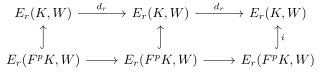
and the image of the vertical inclusions is F_\mathrm{rec}^p(E_r(K,W)). Since i is injective, \begin{aligned} F_\mathrm{rec}^p(E_{r+1}(K,W)) &= \operatorname{Im}\Big( \operatorname{Ker}\big(F_\mathrm{rec}^pE_r(K,W)\xrightarrow{d_r}E_r(K,W) \big) \to E_{r+1}(K,W) \Big) \\&= \operatorname{Im}\Big( \operatorname{Ker}\big( E_r(F^pK,W)\xrightarrow{d_r}E_r(F^pK,W) \big) \to E_{r+1}(K,W) \Big) \\&= \operatorname{Im}\big( E_{r+1}(F^pK,W) \to E_{r+1}(K,W) \big). \end{aligned} If r<r_0, then d_r is strictly compatible with F_\mathrm{rec}, whence d_rE_r(K,W)\cap E_r(F^pK,W) = d_rE_r(F^pK,W) and E_{r+1}(F^pK,W) thus injects into E_{r+1}(K,W). This proves (*)_{r+1}.
The statements (*)_r, combined with the dual statements, implies (ii).
It follows from (ii) that, for r<r_0 and a\leqslant b, E_r(F^bK,W) injects into E_r(F^aK,W), and that the differential d_r of E_r(F^aK,W) is strictly compatible with the first direct filtration of E_r(F^aK,W). We thus deduce, by induction on r<r_0, that the first direct filtration of E_r(F^aK,W) coincides with the recurrent filtration, and (i) then follows.
If (7.2.2) is satisfied for r_0, and r\leqslant r_0+1, then we denote by F the filtration F_d=F_{d^*}=F_\mathrm{rec} of E_r(W,K). The exact sequences from (ii) of (7.2.5)
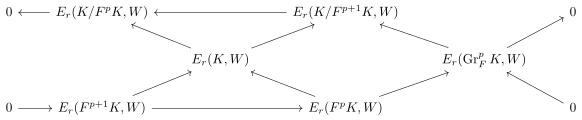
define, for r\leqslant r_0, an (autodual) isomorphism that is compatible with the differentials d_r, namely \operatorname{Gr}_F^p(E_r(K,W)) \simeq E_r(\operatorname{Gr}_F^pK,W) \qquad\text{for }r\leqslant r_0. \tag{7.2.6.1}
If (7.2.2) is satisfied for r_0=\infty, then the sequences 0 \to E_r(F^pK,W) \to E_r(K,W) \to E_r(K/F^pK,W) \to 0 are exact for all r. If the filtration W is biregular, then the sequence 0 \to E_\infty(F^pK,W) \to E_\infty(K,W) \to E_\infty(K/F^pK,W) \to 0 is thus exact. We can rewrite this sequence as 0 \to \operatorname{Gr}_W(\operatorname{H}(F^pK)) \to \operatorname{Gr}_W(\operatorname{H}(K)) \to \operatorname{Gr}_W(\operatorname{H}(K/F^pK)) \to 0.
Let L be a complex endowed with a biregular filtration G. For \operatorname{Gr}_G(L) to be acyclic, it is necessary and sufficient that L be acyclic and that the differentials of L be strictly compatible with the filtration G.
Proof. This is a particular case of (1.3.2).
Applying (7.2.7.1), taking L to be the complex 0 \to \operatorname{H}(F^pK) \to \operatorname{H}(K) \to \operatorname{H}(K/F^pK) \to 0, we see that:
- This sequence is exact, i.e. the differentials of K are strictly compatible with the filtration F;
- the filtration of \operatorname{H}(F^pK) induced by the filtration W of F^pK coincides with the filtration induced by the filtration W of \operatorname{H}(K);
- an analogous statement holds for K/F^pK.
In conclusion:
If (K,F,W) satisfies (7.2.2) for r_0=\infty, then the spectral sequence E(K,F) degenerates (E_1=E_\infty). Furthermore, we have an isomorphism of spectral sequences \operatorname{Gr}_F^p(E_\bullet(K,W)) \simeq E_\bullet(\operatorname{Gr}_F^pK,W).