4.2 The semi-simplicity theorem
Let S be a topological space. A continuous family of Hodge structures on S consists of:
- A local system H_\mathbb{Z} on S of \mathbb{Z}-modules of finite type.
- For every point s\in S, a Hodge structure on the fibre (H_\mathbb{Z}) that varies continuously in s.
A continuous family H of Hodge structures on S is said to be of weight n if the fibres H_s (for s\in S) are all of weight n.
We similarly define a continuous family of Hodge \mathbb{Q}-structures as a local system of \mathbb{Q}-vector spaces, endowed at each point with a Hodge \mathbb{Q}-structure, varying continuously. }
A polarisation of a continuous family H of Hodge \mathbb{Q}-structures of weight n is a morphism of local systems from H_\mathbb{Q}\otimes H_\mathbb{Q} to the constant local system \mathbb{Q}(-n)_\mathbb{Q}, which defines at each point s\in S a polarisation of H_s.
Suppose that S is connected, and let \mathcal{C} be a strictly full subcategory of the category of continuous families of Hodge \mathbb{Q}-structures on S. We will have need of the following conditions:
\mathcal{C} is stable under direct factors, direct sums, and tensor products; the Tate constant families \mathbb{Q}(n) (for n\in\mathbb{Z}) are in \mathcal{C}.
Every homogeneous (of some weight n) Hodge structure in \mathcal{C} is polarisable.
For every H\in\operatorname{Ob}\mathcal{C}, there exists a local system H'_\mathbb{Z} on S of free \mathbb{Z}-modules such that H'_\mathbb{Z}\otimes\mathbb{Q}\approx H_\mathbb{Q}.
For every H\in\operatorname{Ob}\mathcal{C}, the largest constant local system H^f of H is a constant family of Hodge sub-structures of H.
If \mathcal{C} satisfies (4.2.2.1) and (4.2.2.2), then:
- \mathcal{C} is a semi-simple abelian subcategory of the abelian subcategory of continuous families of Hodge \mathbb{Q}-structures on S.
- If H\in\operatorname{Ob}\mathcal{C}, then its dual H^* and the \wedge^p H are also in \mathcal{C}; if H_1,H_2\in\operatorname{Ob}\mathcal{C}, then \operatorname{Hom}(H_1,H_2)\in\operatorname{Ob}\mathcal{C}.
Proof. Let H\in\operatorname{Ob}\mathcal{C}, and let H_1 be a sub-object of H, in the category of continuous families of Hodge \mathbb{Q}-structures. We will show that H_1 is a direct factor of H in this category. We can suppose H to be homogeneous. If \psi is a polarisation form for H, then the orthogonal of H_1 with respect to \psi is indeed a sub-object of H that is a supplement to H_1. This proves (i)
If H\in\operatorname{Ob}\mathcal{C} is of weight n, then a polarisation of H defines an isomorphism between H^* and H\otimes\mathbb{Q}(n). By (4.2.2.1), we thus have that H^*\in\operatorname{Ob}\mathcal{C}. For arbitrary H\in\operatorname{Ob}\mathcal{C}, if we decompose H into its homogeneous components, then H^*=\bigoplus_n(H^n)^*, whence again H^*\in\operatorname{Ob}\mathcal{C}. Finally, \wedge^p H is a direct factor of \bigotimes^p H, and \operatorname{Hom}(H_1,H_2)\simeq H_1^*\otimes H_2.
Let f\colon X\to S be a smooth proper morphism of reduced schemes. The sheaf \mathrm{R}^i f_*\mathbb{Q} is then a local system, and, for s\in S, (\mathrm{R}^i f_*\mathbb{Q})_s\simeq\operatorname{H}^i(X_s,\mathbb{Q}) is endowed with a Hodge \mathbb{Q}-structure, which varies continuously in s.
Let S be a smooth connected scheme. A continuous family H of Hodge \mathbb{Q}-structures on S^\mathrm{an} is said to be algebraic if there exists a non-empty Zariski open U of S, an integer k, and a smooth projective morphism f\colon X\to U such that H|U is a direct factor of \mathrm{R}f_*\mathbb{Q}\otimes\mathbb{Q}(k).
—
- The category of algebraic continuous families of Hodge \mathbb{Q}-structures on S satisfies the conditions of (4.2.2).
- If a continuous family H of Hodge structures on S is such that its restriction to a dense Zariski open U of S is algebraic, then H is algebraic.
- If f\colon X\to S is smooth and proper, then \mathrm{R}f_*\mathbb{Q} is algebraic.
Proof. Claim (ii) is evident. We will prove (i). Let \mathcal{C}_0 be the set of continuous families of Hodge structures on S that are of the form \mathrm{R}f_*\mathbb{Q} (with f smooth and projective). Then:
- By the Künneth formula \mathrm{R}(f\times g)_*\mathbb{Q} \simeq \mathrm{R}f_*\mathbb{Q}\otimes\mathrm{R}g_*\mathbb{Q}, \mathcal{C}_0 is stable under tensor products.
- Since \mathrm{R}(f\sqcup g)_*\mathbb{Q} \simeq \mathrm{R}f_*\mathbb{Q}\oplus\mathrm{R}g_*\mathbb{Q}, \mathcal{C}_0 is stable under direct sums.
- The homogeneous components of each H\in\operatorname{Ob}\mathcal{C}_0 are polarisable (cf. (2.2.6)).
- The objects H\in\operatorname{Ob}\mathcal{C}_0 satisfy (4.2.2.3), since \mathrm{R}f_*\mathbb{Q} \simeq \mathrm{R}f_*\mathbb{Z}\otimes\mathbb{Q}.
- The objects H\in\operatorname{Ob}\mathcal{C}_0 satisfy (4.2.2.4), by (4.1.2).
Let \mathcal{C}_1 be the set of direct factors of objects of \mathcal{C}_0. Then \mathcal{C}_1 is stable under tensor products, direct sums, and direct factors, and satisfies (4.2.2.2), (4.2.2.3), and (4.2.2.4). Furthermore, \mathbb{Q}(-1) is in \mathcal{C}_1, in the form of \mathrm{R}^2 f_*\mathbb{Q} for f\colon\mathbb{P}_S^1\to S the projective bundle. The category \mathcal{C}_2 consisting of the H\otimes\mathbb{Q}(k) (for k\in\mathbb{N}) thus satisfy all the conditions of (4.2.2).
To thus deduce (i), it suffices to note that, if H is a continuous family of Hodge structures, and U a dense Zariski open of S, then a sub-object of, a polarisation on, or an integer lattice of H|U uniquely extend to H.
We now prove (iii). If f\colon X\to S is smooth and projective, then there exists a dense Zariski open subset U of S along with a commutative diagram
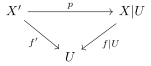
with f' smooth and projective, and p birational and surjective (by applying Chow’s lemma and the resolution of singularities to the generic fibre of f). The restriction map p^*\colon (\mathrm{R}f_*\mathbb{Q})|U \to \mathrm{R}f'_*\mathbb{Q} is thus a direct injection of continuous families of Hodge structures, with left inverse given by the Gysin morphism p_!, whence the algebraicity of \mathrm{R}f_*\mathbb{Q}.
Let S be a connected topological space that is locally connected and locally simply connected, endowed with a basepoint s. Let \mathcal{C} be a category of continuous Hodge structures on S that satisfy the conditions of (4.2.2). Then, if H\in\operatorname{Ob}\mathcal{C}, the representation of \pi_1(S,s) on the fibre (H_\mathbb{Q})_s is semi-simple.
(Adding during editing). Let S be a smooth connected scheme. A family of Hodge structures on S is a continuous family H of Hodge structures on S that satisfies the following conditions:
- The Hodge filtration on (H_\mathbb{C})_s varies holomorphically with s, i.e. it corresponds to a filtration F of H_\mathcal{O}=H_\mathbb{Z}\otimes\mathcal{O}.
- The covariant derivative \nabla satisfies \nabla F^p\subset\Omega_S^1\otimes F^{p-1}.
Let \mathcal{C} be the category of such continuous families of Hodge \mathbb{Q}-structures on S that underlie a family of Hodge structures and whose homogeneous direct factors are polarisable. It is clear that \mathcal{C} satisfies (4.2.2.1), (4.2.2.2), and (4.2.2.3). We can deduce from results of W. Schmid (August 1970, unpublished) and P.A. Griffiths (Griffiths 1970) that \mathcal{C} satisfies (4.2.2.4). This theorem, of which (4.1.2) is a corollary, allows us to apply (4.2.6) and its corollaries to the objects of \mathcal{C}.
Let H\in\operatorname{Ob}\mathcal{C}. The local system H_\mathbb{Q} defines a complex local system H_\mathbb{C}=H_\mathbb{Q}\otimes\mathbb{C}. For every complex local system V on S, we denote by V^\mathrm{c} the complex vector bundle that it defines, identified with the sheaf of its continuous sections. }
By definition, the group S (from (2.1.2)) acts on H_\mathbb{C}^\mathrm{c}. A sub-bundle of H_\mathbb{C}^\mathrm{c} is said to be horizontal, or locally constant, if it is defined by a local subsystem of H_\mathbb{C}. }
Let V be a rank-1 local subsystem of H_\mathbb{C}. Suppose that the n-th tensor power V^{\otimes n} (for some n\geqslant1) of V is a trivial local system, i.e. that \pi_1(S,s) acts on V_s via a finite (necessarily cyclic) group. Then, for all t\in S, tV^\mathrm{c} is again locally constant.
Proof. In order for tV^\mathrm{c} to be locally constant, it suffices for (tV^\mathrm{c})^{\otimes n}={tV^{c}}^{\otimes n}\subset\bigotimes^n H_\mathbb{C} to be locally constant. But V^{\otimes n} is generated by a horizontal global section v, and, by hypothesis, tv is again horizontal (4.2.2.4).
We proceed by induction on \dim(H_\mathbb{Q})_s. We can suppose H to be homogeneous and non-zero. Let d be the minimal dimension of the non-zero complex local subsystems of H_\mathbb{C}. The sum W of all the local subsystems of H_\mathbb{C} of dimension d (which are automatically simple) is “defined over \mathbb{Q}”, i.e. is of the form W_\mathbb{Q}\otimes\mathbb{C} for W_\mathbb{Q} a local subsystem of H_\mathbb{Q}. By construction, W_s is a semi-simple complex \pi_1(S,s)-module, so (W_\mathbb{Q})s} is a semi-simple \pi_1(S,s)-module over \mathbb{Q}.
Let H_\mathbb{Z} be a local system of free \mathbb{Z}-modules such that H_\mathbb{Z}\otimes\mathbb{Q}\simeq H_\mathbb{Q}, and let W_\mathbb{Z}=H_\mathbb{Z}\cap W_\mathbb{Q}. If W is of dimension e, then the local system (\wedge^e W)^{\otimes2} is trivial. Indeed: \bigwedge^e W \simeq \bigwedge^e W_\mathbb{Z}\otimes\mathbb{C} and \pi_1(S,s) can only act on (\wedge^e W_\mathbb{Z}) by \pm1.
Let V be a complex local subsystem of dimension d of H_\mathbb{C}, and let V' be a complement of V inside W (by the semi-simplicity of W). We have \bigwedge^e W \simeq \bigwedge^d V\otimes\bigwedge^{e-d}V'. Applying (4.2.7) to the local subsystem \wedge^d V\otimes\wedge^{e-d}V' of \wedge^d H_\mathbb{C}\otimes\wedge^{e-d}H_\mathbb{C}, we see that, for t\in S, t\left(\bigwedge^d V\otimes\bigwedge^{e-d}V'\right)^\mathrm{c} = \bigwedge^d tV^\mathrm{c}\otimes\bigwedge^{e-d}t{V'}^\mathrm{c} \subset \bigwedge^d H_\mathbb{C}\otimes\bigwedge^{e-d}H_\mathbb{C} is locally constant. From this, \wedge^d tV^\mathrm{c}\subset\wedge^d H_\mathbb{C} and tV^\mathrm{c}\subset H_\mathbb{C} are locally constant.
By the definition of W, we have tV^\mathrm{c}\subset W^\mathrm{c}, since W^\mathrm{c} is stable under S, and W_\mathbb{Q} is a Hodge sub-structure of H. If \psi is a polarisation of H, then H is thus the direct sum of W and its orthogonal, which are both in \mathcal{C}, and we conclude by induction.
Under the hypotheses of (4.2.6):
- The algebra A of endomorphisms of the local system H_\mathbb{Q} is semi-simple. It admits exactly one Hodge \mathbb{Q}-structure such that, at each point s, the map A\otimes H_s\to H_s is a morphism of Hodge structures.
- The centre of A is of degree (0,0), and the composition law \cdot\colon A\otimes A\to A is a morphism of Hodge structures.
- Let W be a complex local subsystem of dimension d of H_\mathbb{C}. Then:
- For t\in S, tW^\mathrm{c}\subset H_\mathbb{C} is locally constant, and defines a local subsystem tW which is isomorphic to W.
- Some power (\wedge^d W)^{\otimes n} (for some n\geqslant1) of the local system \wedge^d W is a trivial local system.
Proof. The algebra A is the commutator of \pi_1(S,s) in (H_\mathbb{Q})s}. Its semi-simplicity thus follows from (4.2.6) and from Bourbaki, Algèbre commutative, Chapter 8, §5.2, Proposition 4. The algebra A is also the fibre of the largest constant local subsystem of \underline{\operatorname{Hom}}(H_\mathbb{Q},H_\mathbb{Q}). Since \underline{\operatorname{Hom}}(H,H)\in\mathbb{C} (by (ii) of (4.2.3)), the existence of the Hodge structure in (i) follows from the hypotheses (4.2.2.4). It is clear that the composition law is a morphism of Hodge structures. It thus follows that the centre Z of A is a Hodge substructure: Z_\mathbb{C} is bigraded, as the intersection of kernels of bihomogeneous morphisms [x,-], for x bihomogeneous. Finally, Z, and thus Z_\mathbb{C}, is semi-simple, and, for (p,q)neq(0,0), Z^{pq} is zero and thus nilpotent.
A complex local subsystem W of H_\mathbb{C} is defined by a projector e of A_\mathbb{C}. For t\in S, tW^\mathrm{c} is defined by the projector t\cdot e, and is thus locally constant. Since the group S is connected, to show that tW is isomorphic to W, it suffices to show that, for t in a small enough neighbourhood of 1, the \mathbb{C}[\pi_1(S,s)] module tW_s is isomorphic to W_s. Let H_i be the isotypic components of the \mathbb{C}[\pi_1(S,s)]-module (H_\mathbb{C})_s. We have \begin{aligned} W_s &= \bigoplus_i(W_s\cap H_i) \\tW_s &= \bigoplus_i(tW_s\cap H_i). \end{aligned}
Furthermore, for t close enough to 1, tW_s is close to W_s in the Grassmannian, and thus \dim(tW_s\cap H_i) \leqslant \dim(W_s\cap H_i). \tag{4.2.8.1}
In fact, since \dim(tW_s)=\dim(W_s), we have equality in (4.2.8.1). The various isotypic components of W_s and tW_s thus have, respectively, the same length, and W_s is isomorphic to tW_s. }
We now prove (iii.b). It suffices to consider the case where H is homogeneous and W_s is a simple \mathbb{C}[\pi_1(S,s)]-module. Let H_1 be the isotypic component of (H_\mathbb{C})s} that contains W_s. By (a), H_1 is stable under S. If W_s is of dimension d, and H_1 of length k, then \bigwedge^{kd}H_1 \approx \left(\bigwedge^d W_s\right)^{\otimes k} as \mathbb{C}[\pi_1(S,s)]-modules. If \chi is the character of \pi_1(S,s) defined by \wedge^d W, then the character \chi_1 defined by \wedge^{kd}H_1 is thus \chi^k. Let H_2=H_1+\overline{H}_1. Since H_1 is stable under S, H_2 is defined by a real Hodge substructure of (H_\mathbb{R})_s. Every polarisation form on H thus induces on H_2 a non-degenerate bilinear form that is \pi_1(S,s)-invariant. If \dim(H_2)=e, then the representation (\wedge^e H_2)^{\otimes2} of \pi_1(S,s) is thus trivial. From this:
- For real H_1, \chi^{2k} is trivial.
- For non-real H_1 (so H_1\neq\overline{H}_1), \chi^{2k}\cdot\overline{\chi}^{2k} is trivial.
In both cases, |\chi|=1.
The representation of \pi_1(S,s) on (H_\mathbb{C})_s comes from extension of scalars of a representation defined over \mathbb{Q} (namely (H_\mathbb{Q})_s). The conjugate representations of W thus appear in (H_\mathbb{C})_s; there are at most N=\dim(H) of them, and for every automorphism \sigma of \mathbb{C} we have |\sigma(\chi)| = 1.
For \gamma\in\pi_1(S,s), \chi(\gamma) is an algebraic integer with at most N complex conjugates, and these are all of absolute value 1; thus \chi(\gamma) is a k-th root of unity, with k\leqslant N. Thus \chi^{N!}=1, which proves (b).
Let S be a smooth, connected, separated scheme, endowed with a base point s\in S. Let f\colon X\to S be a morphism of schemes such that \mathrm{R}^nf_*\mathbb{Q} is a local system on S. Let G be the Zariski closure of the image of \pi_1(S,s) in \operatorname{Aut}_\mathbb{C}((\mathrm{R}^nf_*\mathbb{C})_s), and G^0 the identity component of G. Then:
- If f is smooth and proper, then G^0 is semi-simple.
- In general, G^0 does not admit any quotient of multiplicative type (i.e. the radical of G^0 is unipotent).
Proof. We first prove (a). By replacing S by a finite étale cover, if necessary, we can reduce to the case where G=G^0. By (iii) of (4.2.5), the local system \mathrm{R}^nf_*\mathbb{Q} underlies an algebraic family H of Hodge structures, and so we can apply (4.2.8) (by (i) of (4.2.5)). The group G is reductive, since it admits a faithful semi-simple representation (namely (\mathrm{R}^nf_*\mathbb{C})_s). If G (which we assume to be connected) were not semi-simple, then it would admit a non-trivial complex representation \rho of rank 1; since H_s is faithful, \rho would then be a direct factor of ((H+H^*)_\mathbb{C}^{\otimes m})_s for some m. But this would contradict (iii.b) of (4.2.8), since (H+H^*)^{\otimes m} is algebraic, and no tensor power of \rho is trivial.
Let \pi be a group, and consider the following property of a representation \rho of \pi in a complex vector space V of finite dimension:
The identity component G^0 of the Zariski closure G of \rho(\pi) in \operatorname{Aut}(V) does not admit any quotient of multiplicative type.
Let 0\to V'\to V\to V''\to0 be an exact sequence of representations of the above type. Then V satisfies (*) if (and only if) V' and V'' satisfy (*).
Proof. Let G, G', and G'' be the groups defined by V, V', and V'', respectively. Then V' is stable under G, just as it is under \pi, whence a morphism u = (u',u'')\colon G\to G'\times G'' with unipotent kernel, and such that u' and u'' are surjective. Let N be the identity component of the kernel of u''. Since u' is surjective, u'(N) is distinguished in G', and thus does not admit any quotient of multiplicative type. If \chi is a character of G^0, then \chi factors through u(G^0) and vanishes on N; then a power of \chi factors through {G''}^0, and so \chi is trivial.
We now prove part (b) of (4.2.9) by dévissage, and by induction on the relative dimension of f. We can suppose X to be reduced.
Suppose first of all that X is quasi-projective. Then there exists a non-empty open U of S, a dense open X' of X_U=f^{-1}(U) that is smooth over U, and a compactification \overline{X}' of X' that is smooth and proper over U. We can choose \overline{X}' to be such that some open X'' of \overline{X}' contains X' and is proper over X_U.
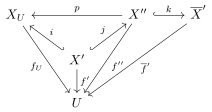
We have long exact sequences of sheaves \begin{gathered} \ldots \to \mathrm{R}^i{f_U}_*(i_!\mathbb{Q}) \to \mathrm{R}^i{f_U}_*\mathbb{Q} \to \mathrm{R}^i{f_U}_*(\mathbb{Q}/i_!\mathbb{Q}) \to \ldots \\\ldots \to \mathrm{R}^i{f''_U}_*(j_!\mathbb{Q}) \to \mathrm{R}^i{f''_U}_*\mathbb{Q} \to \mathrm{R}^i{f''_U}_*(\mathbb{Q}/j_!\mathbb{Q}) \to \ldots \\\ldots \to \mathrm{R}^i f''_!\mathbb{Q} \to \mathrm{R}^i\overline{f}'_*\mathbb{Q} \to \mathrm{R}^i\overline{f}'_*(\mathbb{Q}/k_!\mathbb{Q}) \to \ldots \end{gathered}
For small enough U, these sheaves are local systems, and the induction hypothesis applies to \mathrm{R}^\bullet{f_U}_*(\mathbb{Q}/i_!\mathbb{Q}), to \mathrm{R}^\bullet{f''}_*(\mathbb{Q}/j_!\mathbb{Q}), and to \mathrm{R}^\bullet\overline{f}'_*(\mathbb{Q}/k_!\mathbb{Q}). By (a) of (4.2.9), (*) is satisfied by \mathrm{R}^\bullet\overline{f}'_*\mathbb{Q}. By (4.2.10), (*) is then also satisfied by \mathrm{R}^\bullet{f''}_!\mathbb{Q}, and by the dual local system \mathrm{R}^\bullet\overline{f}'_*\mathbb{Q} (Poincaré duality). By (4.2.10), (*) is satisfied by \mathrm{R}^\bullet{f''}_*(j_!\mathbb{Q}), which is isomorphic to \mathrm{R}^\bullet{f_U}_*(i_!\mathbb{Q}), since p is proper, as well as by \mathrm{R}^\bullet{f_U}_*\mathbb{Q}. Since the morphism \pi_1(U)\to\pi_1(S) is surjective, \mathrm{R}^if_*\mathbb{Q} satisfies (b) of (4.2.9).
To pass from the case where f is quasi-projective to the general case, it suffices to use the Leray spectral sequence for a cover (U_i) of X by quasi-projective opens: \mathrm{R}^\bullet f_*\left(\bigcap_i U_i,\mathbb{Q}\right) \Rightarrow\mathrm{R}^\bullet f_*\mathbb{Q} along with (4.2.10).